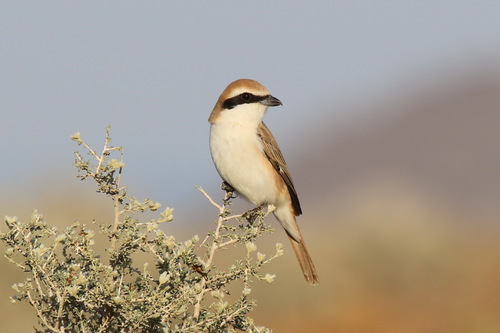
Grey-backed Fiscal

Grey-backed Fiscal

Lanius excubitoroides

Silhouette: Andy Wilson · PhyloPic

LCLeast ConcernNTVUENCR
Daily sighting probability ~40% · Likely
at Masai Mara National Reserve

In 3 days ~80% in a week >90%

1,492 Verified sightings at Masai Mara National Reserve From 2019 to 2026
7,156 In all 18 parks
January Best month
☀️ Diurnal When it's spotted

About the Grey-backed Fiscal

The grey-backed fiscal (Lanius excubitoroides) is a species of bird in the family Laniidae. It is found in Burundi, Cameroon, Central African Republic, Chad, Democratic Republic of the Congo, Ethiopia, Kenya, Mali, Mauritania, Nigeria, Rwanda, Sudan, Tanzania, and Uganda. Its natural habitats are dry savanna and subtropical or tropical dry lowland grassland.

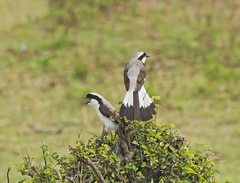
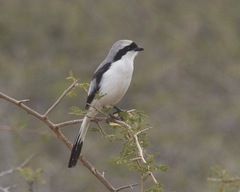
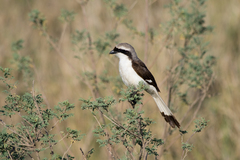
This is a large shrike with a length of about 25 cm (10 in). The head of the male has a grey crown, a white supercilium and a large black mask. The upper parts are medium grey, the rump is white, the wings are blackish, with a white patch which is conspicuous in flight, and the long tail has a white base and a black tip. The underparts and base of the underside of the tail are white. The female is similar but has patches of chestnut on the flanks that are visible during display and when the bird is preening. The juvenile is brownish with brown wings and tail and is heavily barred with grey.

The grey-backed fiscal is a sociable bird and is often found in wooded grassland, gardens and damp acacia scrub. It is often seen in pairs or small groups on tree stumps, wires and branches, engaged in wing fluttering... Wikipedia →

Sounds

Call0:54

Burundi · 2025

© Bram Piot · XC973505 · CC BY-NC-SA 4.0

Song0:42

Kenya · 2017

© James Bradley · XC396326 · CC BY-NC-SA 4.0

Call0:39

Tanzania · 2022

© isaac kilusu · XC772440 · CC BY-NC-SA 4.0

Global Distribution

Parks Where Found

# Park Country Daily sighting probability
1 Lake Nakuru National Park 🇰🇪 Kenya
~60%
2 Akagera National Park 🇷🇼 Rwanda
~60%
3 Queen Elizabeth National Park 🇺🇬 Uganda
~60%
4 Kidepo Valley National Park 🇺🇬 Uganda
~50%
5 Murchison Falls National Park 🇺🇬 Uganda
~50%
6 Serengeti National Park 🇹🇿 Tanzania
~50%
7 Masai Mara National Reserve 🇰🇪 Kenya
~40%
8 Lake Mburo National Park 🇺🇬 Uganda
~40%
9 Virunga National Park 🇨🇩 Democratic Republic of the Congo
~20%
10 Ngorongoro Conservation Area 🇹🇿 Tanzania
~10%
11 Tarangire National Park 🇹🇿 Tanzania
<5%
12 Volcanoes National Park 🇷🇼 Rwanda
<5%
13 Bwindi Impenetrable National Park 🇺🇬 Uganda
<5%
14 Nyungwe National Park 🇷🇼 Rwanda
<5%
15 Semuliki National Park 🇺🇬 Uganda
<5%
16 Lake Manyara National Park 🇹🇿 Tanzania
<5%
17 Kibale National Park 🇺🇬 Uganda
<5%
18 Arusha National Park 🇹🇿 Tanzania
<5%

Cities Where Found

# City Country Daily sighting probability
1 Kigali 🇷🇼 Rwanda
~50%
2 Bujumbura 🇧🇮 Burundi
~20%
3 Kampala 🇺🇬 Uganda
<5%

Before you go

What are the chances of seeing a Grey-backed Fiscal in Masai Mara National Reserve?

Likely

About 40% of wildlife watchers report a Grey-backed Fiscal sighting in Masai Mara National Reserve on a given day, based on 1,492 verified sightings from GBIF citizen-science data from 2019 to 2026. It is the 16th most-seen of the 398 birds we can rate there. Over three days the chance rises to about 80%, and over a week to over 90%, if each day is a fresh chance.

When is the best time to see a Grey-backed Fiscal in Masai Mara National Reserve?

January and August–September

In those months about 50% of wildlife watchers report a Grey-backed Fiscal in Masai Mara National Reserve on a given day, against about 30% in December, the lowest month.

What time of day is best to see a Grey-backed Fiscal?

Between 8 and 11 am

Across all the parks we cover, that three-hour window holds the most Grey-backed Fiscal sightings with a recorded time, and about 8 in 10 of them come between 6 am and 6 pm: it is a daytime animal.

Where does the Grey-backed Fiscal sighting chance come from?

GBIF citizen-science records

It is estimated from how often the Grey-backed Fiscal is recorded against all the birds logged in Masai Mara National Reserve (1,492 verified sightings from 2019 to 2026), calibrated against known sighting rates. Figures are rounded to the nearest 10% because citizen-science data supports honest approximations, not decimals, and months with records from fewer than five people show "—". How it works.

← Back to Masai Mara National Reserve