Chicken Turtle

Chicken Turtle

Deirochelys reticularia

Silhouette: SeismicShrimp · PhyloPic

Endemic
Daily sighting probability ~10% · With luck
at Merritt Island National Wildlife Refuge

In 3 days ~20% in a week ~40%

29 Verified sightings at Merritt Island National Wildlife Refuge From 2019 to 2026
110 In all 3 parks
September Best month
☀️ Diurnal When it's spotted

About the Chicken Turtle

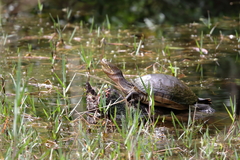
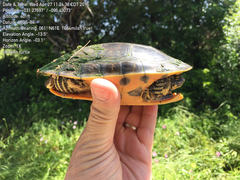
The chicken turtle (Deirochelys reticularia) is a turtle native to the southeastern United States. It is the only extant member of the genus Deirochelys and is a member of the freshwater marsh turtle family Emydidae. The chicken turtle's scientific name refers to its extremely long neck and distinctive net-like pattern on its upper shell. There are three regionally distinct subspecies (eastern, western and Florida), which are thought to have evolved when populations became separated during periods of glaciation. These subspecies can be distinguished by their appearance; the western chicken turtle displays dark markings along the seams of its plastron (lower shell), while the plastron of the Florida subspecies is a bright yellow or orange color. Fossil records show that the chicken turtle has been present in the region for up to five million years.

Chicken turtles inhabit shallow, still or slow-moving bodies of water with plenty of vegetation and a muddy substrate. They are not found in rivers or deeper lakes that may be home to predators such as alligators and large fish. The chicken turtle is predominantly carnivorous and feeds mostly on invertebrates such as crayfish, dragonflies and spiders, but is also known to eat tadpoles, carrion and occasionally plant material. It is an active hunter and its long neck allows it to catch fast-moving prey. Although feeding and mating take place in aquatic environments, the chicken turtle is very well adapted to living on land and may spend more than half the year out of the water. Like many reptiles, it spends much of the day basking in the sun to regulate its body temperature, but unlike most other aquatic turtles, it hibernates over the winter months except in the warmer, southernmost reaches of its range.

The chicken turtle is relatively small compared to other related turtles, with males measuring up to around 16.5 cm (6.5 in) and females around 26.0 cm (10.2 in). It is also one of the world's shortest-lived turtles, reaching a maximum age of 20–24 years. There are thought to be around 100,000 adult chicken turtles in the wild. Although the population as a whole is considered secure, its status in some areas is less certain and several states have listed it as threatened or introduced regulations to manage hunting or taking. The word "chicken" in the turtle's vernacular name is apparently a reference to the taste of its meat, which was once popular in turtle soup and commonly sold in southern markets. Wikipedia →

Global Distribution

Parks Where Found

# Park Country Daily sighting probability
1 Big Cypress National Preserve 🇺🇸 United States
~10%
2 Everglades National Park 🇺🇸 United States
~10%
3 Merritt Island National Wildlife Refuge 🇺🇸 United States
~10%

Zoos & Centres Where Found

# Zoo / Centre Country
1 Moscow Zoo 🇷🇺 Russia In captivity
2 Brookfield Zoo 🇺🇸 United States In captivity
3 Zoo Koki (Parque zoológico y botánico) 🇪🇸 Spain In captivity
4 South Carolina Aquarium 🇺🇸 United States In captivity
5 Flint RiverQuarium 🇺🇸 United States In captivity
6 Tennessee Aquarium 🇺🇸 United States In captivity
7 UGA Marine Education Center and Aquarium 🇺🇸 United States In captivity
8 Zoológico Miguél Álvarez del Toro 🇲🇽 Mexico In captivity

Before you go

What are the chances of seeing a Chicken Turtle in Merritt Island National Wildlife Refuge?

With luck

About 10% of wildlife watchers report a Chicken Turtle sighting in Merritt Island National Wildlife Refuge on a given day, based on 29 verified sightings from GBIF citizen-science data from 2019 to 2026. It is the 31st most-seen of the 35 reptiles we can rate there. Over three days the chance rises to about 20%, and over a week to about 40%, if each day is a fresh chance.

When is the best time to see a Chicken Turtle in Merritt Island National Wildlife Refuge?

April–May and August–January

In those months about 10% of wildlife watchers report a Chicken Turtle in Merritt Island National Wildlife Refuge on a given day, against under 5% in February–March and June–July, the lowest months.

What time of day is best to see a Chicken Turtle?

Between 10 am and 1 pm

Across all the parks we cover, that three-hour window holds the most Chicken Turtle sightings with a recorded time, and about 9 in 10 of them come between 6 am and 6 pm: it is a daytime animal.

Is Merritt Island National Wildlife Refuge the best place to see a Chicken Turtle?

Among the best

Of the 3 parks where we can rate Chicken Turtle sightings, Merritt Island National Wildlife Refuge ranks 3rd at about 10%, level with the leaders once rounded. The best odds are in Big Cypress National Preserve (United States, about 10%) and Everglades National Park (United States, about 10%).

Which relatives of the Chicken Turtle live in Merritt Island National Wildlife Refuge?

Same family: Emydidae

The closest relatives of the Chicken Turtle that you can see in Merritt Island National Wildlife Refuge (family Emydidae, Pond and Box Turtles) are Peninsular Cooter (about 30%), Common Box Turtle (about 10%) and Florida Redbelly Turtle (about 10%), with each one's daily chance of a sighting.

Where does the Chicken Turtle sighting chance come from?

GBIF citizen-science records

It is estimated from how often the Chicken Turtle is recorded against all the reptiles logged in Merritt Island National Wildlife Refuge (29 verified sightings from 2019 to 2026), calibrated against known sighting rates. Figures are rounded to the nearest 10% because citizen-science data supports honest approximations, not decimals, and months with records from fewer than five people show "—". How it works.

← Back to Merritt Island National Wildlife Refuge