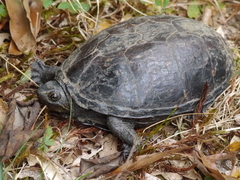
Striped Mud Turtle

Striped Mud Turtle

Kinosternon baurii

Silhouette: Jose Carlos Arenas-Monroy · PhyloPic

LCNTNear ThreatenedVUENCR Endemic
Daily sighting probability ~10% · With luck
at Merritt Island National Wildlife Refuge

In 3 days ~30% in a week ~50%

17 Verified sightings at Merritt Island National Wildlife Refuge From 2019 to 2026
287 In all 3 parks
May Best month
☀️ Diurnal When it's spotted

About the Striped Mud Turtle

The striped mud turtle (Kinosternon baurii) is a species of turtle in the family Kinosternidae. The species is native to the southeastern United States. The specific name, baurii, is in honor of herpetologist Georg Baur.

The striped mud turtle is found in Florida, Georgia, North Carolina, South Carolina, Maryland, and Virginia. K. baurii has three light-colored stripes along the length of the smooth carapace. It can grow to a straight carapace length of 8–12 cm (3–4¾ inches).

K. baurii is a common species found in freshwater habitats. It wanders about on land more than any other of the mud turtles and can sometimes be observed foraging for food in cow dung. The striped mud turtle is omnivorous. It eats insects, snails, fish, carrion, algae, and plants. The striped mud turtle also eats dried up krill.

As a pet K. baurii is easy to care for, readily eating commercial turtle foods, feeder fish, and worms. Kept communally, they may exhibit aggressive behavior towards each other, most likely males are more inclined to fight than females.

Adult females of K. baurii... Wikipedia →

Global Distribution

Parks Where Found

# Park Country Daily sighting probability
1 Big Cypress National Preserve 🇺🇸 United States
~30%
2 Everglades National Park 🇺🇸 United States
~30%
3 Merritt Island National Wildlife Refuge 🇺🇸 United States
~10%

Cities Where Found

# City Country Daily sighting probability
1 Orlando 🇺🇸 United States
~10%
2 Miami 🇺🇸 United States
<5%

Zoos & Centres Where Found

# Zoo / Centre Country
1 Greensboro Science Center 🇺🇸 United States In captivity
2 Dauphin Island Audubon Bird Sanctuary 🇺🇸 United States In captivity
3 Xpark 🇹🇼 Taiwan In captivity

Closest Relatives at Merritt Island National Wildlife Refuge

No species of the same family or order lives in Merritt Island National Wildlife Refuge, so these are its closest relatives here: other reptiles.

Before you go

What are the chances of seeing a Striped Mud Turtle in Merritt Island National Wildlife Refuge?

With luck

About 10% of wildlife watchers report a Striped Mud Turtle sighting in Merritt Island National Wildlife Refuge on a given day, based on 17 verified sightings from GBIF citizen-science data from 2019 to 2026. It is the 22nd most-seen of the 35 reptiles we can rate there. Over three days the chance rises to about 30%, and over a week to about 50%, if each day is a fresh chance.

When is the best time to see a Striped Mud Turtle in Merritt Island National Wildlife Refuge?

May and October

In those months about 20% of wildlife watchers report a Striped Mud Turtle in Merritt Island National Wildlife Refuge on a given day, against under 5% in August and November–December, the lowest months.

What time of day is best to see a Striped Mud Turtle?

Between 9 am and noon

Across all the parks we cover, that three-hour window holds the most Striped Mud Turtle sightings with a recorded time, and about 7 in 10 of them come between 6 am and 6 pm: it is a daytime animal.

Is Merritt Island National Wildlife Refuge the best place to see a Striped Mud Turtle?

3rd of 3

Of the 3 parks where we can rate Striped Mud Turtle sightings, Merritt Island National Wildlife Refuge ranks 3rd at about 10%. The best odds are in Big Cypress National Preserve (United States, about 30%) and Everglades National Park (United States, about 30%).

Where does the Striped Mud Turtle sighting chance come from?

GBIF citizen-science records

It is estimated from how often the Striped Mud Turtle is recorded against all the reptiles logged in Merritt Island National Wildlife Refuge (17 verified sightings from 2019 to 2026), calibrated against known sighting rates. Figures are rounded to the nearest 10% because citizen-science data supports honest approximations, not decimals, and months with records from fewer than five people show "—". How it works.

← Back to Merritt Island National Wildlife Refuge