Oak Toad

Oak Toad

Anaxyrus quercicus

Silhouette: Michael Scroggie, from original photograph by Gary M. Stolz, USFWS (original photograph in public domain). · PhyloPic

LCLeast ConcernNTVUENCR Endemic
Daily sighting probability ~10% · With luck
at Merritt Island National Wildlife Refuge

In 3 days ~20% in a week ~30%

6 Verified sightings at Merritt Island National Wildlife Refuge From 2019 to 2026
61 In all 3 parks
June Best month
☀️🌙 Day & Night When it's spotted

About the Oak Toad

The oak toad (Anaxyrus quercicus) is a species of toad in the family Bufonidae that is endemic to the coastal regions of southeastern United States. It is regarded as the smallest species of toad in North America, with a length of 19 to 33 mm (0.75 to 1.30 in).

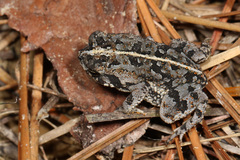
The oak toad may be identified by its light mid-dorsal stripe, variable brown and black spots, and proportionally large parotoid glands. The female has a dark-spotted belly and the male has a clear white belly with a slightly distended, loose flap of skin beneath the mouth that expands into a vocal sac. As noted above, one of the most remarkable features of this species is its small adult size relative to other toads.

The oak toad is native to the coastal regions of the southeastern United States, ranging from eastern Louisiana to southeast Virginia and south throughout Florida. It is found in a variety of habitats, including sandy pine flatwoods and oak scrub, open pine and pine-oak woods, pine or oak savanna with sandy soils, and maritime forests. Oak toads prefer open-canopied pine flatwoods with grassy ground cover. They are generally found in moist, grassy areas near pine... Wikipedia →

Sounds

Advertisement call0:14

United States · 2018

© Chris Harrison · XC890995 · CC BY-NC-SA 4.0

Recording0:09

United States · 2026

© Andrew Hopkins · iNaturalist · CC BY-NC 4.0

Recording0:12

United States · 2026

© sghereford · iNaturalist · CC BY-NC 4.0

Global Distribution

Parks Where Found

# Park Country Daily sighting probability
1 Big Cypress National Preserve 🇺🇸 United States
~30%
2 Everglades National Park 🇺🇸 United States
~10%
3 Merritt Island National Wildlife Refuge 🇺🇸 United States
~10%

Cities Where Found

# City Country Daily sighting probability
1 Miami 🇺🇸 United States
<5%

Before you go

What are the chances of seeing an Oak Toad in Merritt Island National Wildlife Refuge?

With luck

About 10% of wildlife watchers report an Oak Toad sighting in Merritt Island National Wildlife Refuge on a given day, based on 6 verified sightings from GBIF citizen-science data from 2019 to 2026. It is the 8th most-seen of the 9 amphibians we can rate there. Over three days the chance rises to about 20%, and over a week to about 30%, if each day is a fresh chance.

When is the best time to see an Oak Toad in Merritt Island National Wildlife Refuge?

April–June and August

In those months about 10% of wildlife watchers report an Oak Toad in Merritt Island National Wildlife Refuge on a given day, against under 5% in July and September–March, the lowest months.

What time of day is best to see an Oak Toad?

Between 11 am and 2 pm

Across all the parks we cover, that three-hour window holds the most Oak Toad sightings with a recorded time, and about 7 in 10 of them come between 6 am and 6 pm: it is seen both by day and at night.

Is Merritt Island National Wildlife Refuge the best place to see an Oak Toad?

3rd of 3

Of the 3 parks where we can rate Oak Toad sightings, Merritt Island National Wildlife Refuge ranks 3rd at about 10%. The best odds are in Big Cypress National Preserve (United States, about 30%) and Everglades National Park (United States, about 10%).

Where does the Oak Toad sighting chance come from?

GBIF citizen-science records

It is estimated from how often the Oak Toad is recorded against all the amphibians logged in Merritt Island National Wildlife Refuge (6 verified sightings from 2019 to 2026), calibrated against known sighting rates. Figures are rounded to the nearest 10% because citizen-science data supports honest approximations, not decimals, and months with records from fewer than five people show "—". How it works.

← Back to Merritt Island National Wildlife Refuge