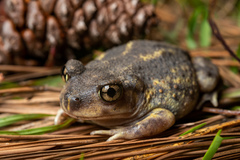

Eastern Spadefoot

Eastern Spadefoot

Scaphiopus holbrookii

Silhouette: Jose Carlos Arenas-Monroy · PhyloPic

LCLeast ConcernNTVUENCR Endemic
Daily sighting probability ~10% · With luck
at Merritt Island National Wildlife Refuge

In 3 days ~20% in a week ~50%

116 Verified sightings at Merritt Island National Wildlife Refuge From 2019 to 2026
134 In all 2 parks
December Best month
🌙 Nocturnal When it's spotted

About the Eastern Spadefoot

Scaphiopus holbrookii, commonly known as the eastern spadefoot, is a species of American spadefoot toad (family Scaphiopodidae) endemic to the eastern United States. It is not considered a true toad, with Bufonidae being the family of "true toads".

The epithet, holbrookii, is in honor of John Edwards Holbrook, American herpetologist. A similar species is Hurter's spadefoot toad, which was once considered a subspecies of S. holbrookii. Unlike some other spadefoot toad species, such as Spea multiplicata (the Mexican or desert spadefoot) or Spea bombifrons (the plains spadefoot toad), Scaphiopus holbrookii never naturally develop cannibal tadpoles through phenotypic plasticity. Researchers at the University of North Carolina at Chapel Hill believe this is because the eastern spadefoot is most representative of the first spadefoot toads to evolve.

It is mostly found in the southeastern United States, except for mountainous areas, and is also found northward along the Atlantic coast into southern New England, where it is considered rare. It is found in inland states such as Pennsylvania and New York, but only as far westward as the Appalachian... Wikipedia →

Sounds

Recording0:26

United States · 2024

© soulflower_ecological · iNaturalist · CC BY-NC 4.0

Recording0:06

United States · 2024

© Cole Tiemann · iNaturalist · CC BY-NC 4.0

Recording0:32

United States · 2025

© Leila Dasher · iNaturalist · CC BY 4.0

Global Distribution

Parks Where Found

# Park Country Daily sighting probability
1 Merritt Island National Wildlife Refuge 🇺🇸 United States
~10%
2 Congaree National Park 🇺🇸 United States
~10%

Cities Where Found

# City Country Daily sighting probability
1 Miami 🇺🇸 United States
<5%

Before you go

What are the chances of seeing an Eastern Spadefoot in Merritt Island National Wildlife Refuge?

With luck

About 10% of wildlife watchers report an Eastern Spadefoot sighting in Merritt Island National Wildlife Refuge on a given day, based on 116 verified sightings from GBIF citizen-science data from 2019 to 2026. It is the 7th most-seen of the 9 amphibians we can rate there. Over three days the chance rises to about 20%, and over a week to about 50%, if each day is a fresh chance.

When is the best time to see an Eastern Spadefoot in Merritt Island National Wildlife Refuge?

December

In that month about 20% of wildlife watchers report an Eastern Spadefoot in Merritt Island National Wildlife Refuge on a given day, against under 5% in April and June, the lowest months.

What time of day is best to see an Eastern Spadefoot?

Between 9 pm and midnight

Across all the parks we cover, that three-hour window holds the most Eastern Spadefoot sightings with a recorded time, and about 8 in 10 of them come between 6 pm and 6 am: it is mostly seen at night.

Is Merritt Island National Wildlife Refuge the best place to see an Eastern Spadefoot?

Yes

Of the 2 parks where we can rate Eastern Spadefoot sightings, Merritt Island National Wildlife Refuge has the highest daily chance: about 10%. Next come Congaree National Park (United States, about 10%).

Which relatives of the Eastern Spadefoot live in Merritt Island National Wildlife Refuge?

Same order: Anura

The closest relatives of the Eastern Spadefoot that you can see in Merritt Island National Wildlife Refuge (order Anura, Frogs and Toads) are Cuban Treefrog (about 20%), Southern Toad (about 20%) and Green Treefrog (about 10%), with each one's daily chance of a sighting.

Where does the Eastern Spadefoot sighting chance come from?

GBIF citizen-science records

It is estimated from how often the Eastern Spadefoot is recorded against all the amphibians logged in Merritt Island National Wildlife Refuge (116 verified sightings from 2019 to 2026), calibrated against known sighting rates. Figures are rounded to the nearest 10% because citizen-science data supports honest approximations, not decimals, and months with records from fewer than five people show "—". How it works.

← Back to Merritt Island National Wildlife Refuge