Pink-breasted Lark

Pink-breasted Lark

Calendulauda poecilosterna

Silhouette: Gossipguy and T. Michael Keesey · PhyloPic

LCLeast ConcernNTVUENCR
Daily sighting probability ~10% · With luck
at Meru National Park

In 3 days ~20% in a week ~40%

7 Verified sightings at Meru National Park From 2019 to 2026
1,770 In all 7 parks
April Best month
☀️ Diurnal When it's spotted

About the Pink-breasted Lark

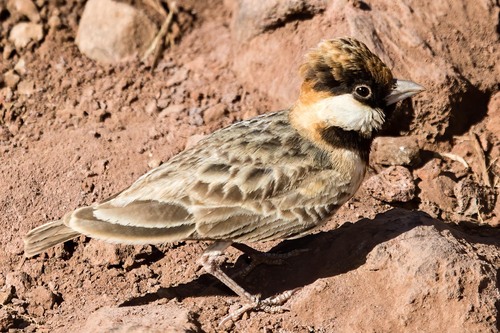
The pink-breasted lark (Calendulauda poecilosterna) or pink-breasted bushlark is a species of passerine bird in the family Alaudidae. This species was originally classified in the genus Alauda and then Mirafra until moved to the new genus Calendulauda in 2009 by the IOC. Not all authorities have followed this taxonomy change.

The pink-breasted lark is estimated to have a global extent of occurrence of 560,000 km2, covering a broad range from south-eastern South Sudan and southern Ethiopia through Kenya to southern Somalia, north-eastern Tanzania and eastern Uganda.

Its natural habitat is dry savannah, open bush and wooded areas, in particular dry acacia and Commiphora scrub. It is generally found singly or in pairs foraging on the ground for insects and seeds. When disturbed it flies to a safe, elevated position on the branch of a tree or the top of a bush. These are also its favoured perches for engaging in territorial song.

Species factsheet - BirdLife International Wikipedia →

Sounds

Song0:55

Kenya · 2024

© Peter Boesman · XC947996 · CC BY-NC-ND 4.0

Call0:41

Kenya · 2018

© Frank Lambert · XC451450 · CC BY-NC-ND 4.0

Song0:44

Kenya · 2022

© Magnus Wadstein · XC775357 · CC BY-NC-SA 4.0

Global Distribution

Parks Where Found

# Park Country Daily sighting probability
1 Samburu National Reserve 🇰🇪 Kenya
~50%
2 Tsavo East National Park 🇰🇪 Kenya
~50%
3 Tsavo West National Park 🇰🇪 Kenya
~50%
4 Mkomazi National Park 🇹🇿 Tanzania
~20%
5 Amboseli National Park 🇰🇪 Kenya
~10%
6 Meru National Park 🇰🇪 Kenya
~10%
7 Tarangire National Park 🇹🇿 Tanzania
<5%

Before you go

What are the chances of seeing a Pink-breasted Lark in Meru National Park?

With luck

About 10% of wildlife watchers report a Pink-breasted Lark sighting in Meru National Park on a given day, based on 7 verified sightings from GBIF citizen-science data from 2019 to 2026. It is the 210th most-seen of the 243 birds we can rate there. Over three days the chance rises to about 20%, and over a week to about 40%, if each day is a fresh chance.

When is the best time to see a Pink-breasted Lark in Meru National Park?

April and October

In those months about 10% of wildlife watchers report a Pink-breasted Lark in Meru National Park on a given day, against under 5% in June, September and November–March, the lowest months. Those are among Meru National Park's wettest months, with about 140 mm of rain a month against almost none in July. May and July–August have too few records to rate.

What time of day is best to see a Pink-breasted Lark?

Between 6 and 9 am

Across all the parks we cover, that three-hour window holds the most Pink-breasted Lark sightings with a recorded time, and about 8 in 10 of them come between 6 am and 6 pm: it is a daytime animal.

Where does the Pink-breasted Lark sighting chance come from?

GBIF citizen-science records

It is estimated from how often the Pink-breasted Lark is recorded against all the birds logged in Meru National Park (7 verified sightings from 2019 to 2026), calibrated against known sighting rates. Figures are rounded to the nearest 10% because citizen-science data supports honest approximations, not decimals, and months with records from fewer than five people show "—". How it works.

← Back to Meru National Park