Pale Batis

Pale Batis

Batis soror

Silhouette: Mathieu Pélissié · PhyloPic

LCLeast ConcernNTVUENCR
Daily sighting probability ~30% · Possible
at Mikumi National Park

In 3 days ~60% in a week ~90%

56 Verified sightings at Mikumi National Park From 2019 to 2026
101 In all 2 parks
July Best month
☀️ Diurnal When it's spotted

About the Pale Batis

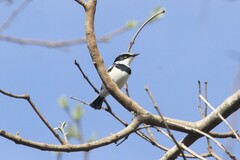
The pale batis (Batis soror), also known as the Mozambique batis or East coast batis, is a species of small bird in the wattle-eyes family, Platysteiridae. It occurs in eastern Africa, mostly in lowland miombo woodland.

The pale batis is an active, black, white and grey bird which is pale grey above with a black face mask bordered by a thin white supercilium, yellow eye and a pale grey back, mottled with faint white spots. It has white underparts marked with a black band across the breast in males; females have a pale rufous breast band and a similar coloured spot on the chin. The bill and legs are black. Immature birds are similar to the female except that the breast band is browner and the underparts have a buffy wash. The pale batis measures 10.5–11.5 cm (4.1–4.5 in) in length and weighs 8–13.1 g (0.28–0.46 oz).

The territorial call of the pale batis is a repeated, mournful, long and piping 3-note "pook pook pook" which is repeated up to 12 times at a constant rate, with which the female duets giving excited "wik-wik" calls. Otherwise the repertoire consists of typical batis bill snaps, churrs and whistles.

Eastern Africa from coastal... Wikipedia →

Sounds

Song0:34

Tanzania · 2019

© Peter Boesman · XC509918 · CC BY-NC-ND 4.0

Call0:12

Mozambique · 2016

© David C. Moyer · XC347181 · CC BY-NC-SA 4.0

Duet0:33

Kenya · 2022

© Lars Lachmann · XC755798 · CC BY-NC-SA 4.0

Global Distribution

Parks Where Found

# Park Country Daily sighting probability
1 Mikumi National Park 🇹🇿 Tanzania
~30%
2 Gorongosa National Park 🇲🇿 Mozambique
~20%

Cities Where Found

# City Country Daily sighting probability
1 Zanzibar City 🇹🇿 Tanzania
~30%

Before you go

What are the chances of seeing a Pale Batis in Mikumi National Park?

Possible

About 30% of wildlife watchers report a Pale Batis sighting in Mikumi National Park on a given day, based on 56 verified sightings from GBIF citizen-science data from 2019 to 2026. It is the 44th most-seen of the 261 birds we can rate there. Over three days the chance rises to about 60%, and over a week to about 90%, if each day is a fresh chance.

When is the best time to see a Pale Batis in Mikumi National Park?

July

In that month about 60% of wildlife watchers report a Pale Batis in Mikumi National Park on a given day, against about 10% in January and April–May, the lowest months. That is one of Mikumi National Park's driest months, with about 25 mm of rain against 200 mm in April.

What time of day is best to see a Pale Batis?

Between 6 and 9 am

Across all the parks we cover, that three-hour window holds the most Pale Batis sightings with a recorded time, and about 9 in 10 of them come between 6 am and 6 pm: it is a daytime animal.

Is Mikumi National Park the best place to see a Pale Batis?

Yes

Of the 2 parks where we can rate Pale Batis sightings, Mikumi National Park has the highest daily chance: about 30%. Next come Gorongosa National Park (Mozambique, about 20%).

Which relatives of the Pale Batis live in Mikumi National Park?

Same genus: Batis

The closest relatives of the Pale Batis that you can see in Mikumi National Park (genus Batis, turtleweeds) are Chinspot Batis (about 10%) and Eastern Black-headed Batis (about 10%), with each one's daily chance of a sighting.

Where does the Pale Batis sighting chance come from?

GBIF citizen-science records

It is estimated from how often the Pale Batis is recorded against all the birds logged in Mikumi National Park (56 verified sightings from 2019 to 2026), calibrated against known sighting rates. Figures are rounded to the nearest 10% because citizen-science data supports honest approximations, not decimals, and months with records from fewer than five people show "—". How it works.

← Back to Mikumi National Park