


Completed


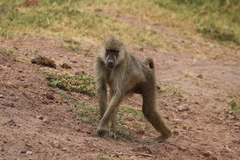


Yellow Baboon
Papio cynocephalus
Silhouette: Owen Jones · PhyloPic
- KingdomAnimalia (Animals)
- PhylumChordata (Chordates)
- ClassMammalia (Mammals)
- OrderPrimates
- FamilyCercopithecidae (Old World Monkeys)
- GenusPapio (Baboons)
- SpeciesPapio cynocephalus (Yellow Baboon)
In 3 days ~90% in a week >90%
33 Verified sightings at Mikumi National Park From 2019 to 2026
384 In all 7 parks
March Best month
☀️ Diurnal When it's spotted
About the Yellow Baboon
The yellow baboon (Papio cynocephalus) is a baboon in the family of Old World monkeys. The species epithet means "dog-head" in Greek, due to the dog-like shape of the muzzle and head. Yellow baboons have slim bodies with long arms and legs along with yellowish-brown hair. They resemble the chacma baboon, but are somewhat smaller and with a less elongated muzzle. Their hairless faces are black, framed with white sideburns. Males can grow to about 84 cm (33 in), females to about 60 cm (24 in). They have long tails which grow to be nearly as long as their bodies. The average life span of the yellow baboon in the wild is roughly 15–20 years; some may live up to 30 years.
Yellow baboons inhabit savannas and light forests in eastern Africa, from Kenya and Tanzania to Zimbabwe and Botswana. They are diurnal, terrestrial, and live in complex, mixed-gender social groups of 8 to 200 individuals per troop. Like all other baboon species, they are omnivorous, with a preference for fruits; they also eat plants, leaves, seeds, grasses, bulbs, bark, blossoms and fungi, as well as worms, grubs, insects, spiders, scorpions, birds, rodents and small mammals. All species of baboons are highly opportunistic feeders and will eat virtually any food they can find.
Baboons fulfill several functions in their ecosystem, not only serving as food for larger predators, but also dispersing seeds in their waste and through their messy foraging habits. They are also efficient predators of smaller animals and their young.
Baboons have been able to fill a variety of ecological niches, including places inhospitable to other animals, such as regions taken over by human settlement. Thus, they are one of the most successful African primates and are not listed as threatened or endangered. However, the same behavioral adaptations that make them so successful also cause them to be considered pests by humans in many areas. Raids on farmers' crops and livestock and other such intrusions into human settlements have made most baboons species subject to many organized extermination projects. However, continued habitat loss forces more and more baboons to migrate toward areas of human settlement.
The two subspecies of the yellow baboon are: Papio cynocephalus cynocephalus (typical yellow baboon) Papio cynocephalus ibeanus (Ibean baboon) Wikipedia →
Recent sightings of Yellow Baboon in Mikumi National Park
LIVEiNaturalistGlobal Distribution
Parks Where Found
| # | Park | Country | Daily sighting probability |
|---|---|---|---|
| 1 | South Luangwa National Park | 🇿🇲 Zambia | |
| 2 | Liwonde National Park | 🇲🇼 Malawi | |
| 3 | Tsavo East National Park | 🇰🇪 Kenya | |
| 4 | Mikumi National Park | 🇹🇿 Tanzania | |
| 5 | Amboseli National Park | 🇰🇪 Kenya | |
| 6 | Tsavo West National Park | 🇰🇪 Kenya | |
| 7 | Ruaha National Park | 🇹🇿 Tanzania |
Zoos & Centres Where Found
| # | Zoo / Centre | Country | |
|---|---|---|---|
| 1 | Greater Vancouver Zoo | 🇨🇦 Canada | |
| 2 | Friguia Park | 🇹🇳 Tunisia | |
| 3 | Wrocław Zoological Garden | 🇵🇱 Poland | |
| 4 | Zoo Aquarium de Madrid | 🇪🇸 Spain | |
| 5 | Rio de Janeiro Zoological Garden | 🇧🇷 Brazil | |
| 6 | Animal Orphanage | 🇰🇪 Kenya | |
| 7 | Africarium | 🇵🇱 Poland | |
| 8 | terrarium ogrodu zoologicznego we Wrocławiu | 🇵🇱 Poland |
Closest Relatives at Mikumi National Park





Before you go
What are the chances of seeing a Yellow Baboon in Mikumi National Park?
Likely
About 60% of wildlife watchers report a Yellow Baboon sighting in Mikumi National Park on a given day, based on 33 verified sightings from GBIF citizen-science data from 2019 to 2026. It is the 9th most-seen of the 15 mammals we can rate there. Over three days the chance rises to about 90%, and over a week to over 90%, if each day is a fresh chance.
When is the best time to see a Yellow Baboon in Mikumi National Park?
March
In that month about 80% of wildlife watchers report a Yellow Baboon in Mikumi National Park on a given day, against about 10% in January, the lowest month. That is one of Mikumi National Park's wettest months, with about 160 mm of rain against 15 mm in June.
What time of day is best to see a Yellow Baboon?
Between 9 am and noon
Across all the parks we cover, that three-hour window holds the most Yellow Baboon sightings with a recorded time, and about 9 in 10 of them come between 6 am and 6 pm: it is a daytime animal.
Is Mikumi National Park the best place to see a Yellow Baboon?
4th of 7
Of the 7 parks where we can rate Yellow Baboon sightings, Mikumi National Park ranks 4th at about 60%. The best odds are in South Luangwa National Park (Zambia, about 70%), Liwonde National Park (Malawi, about 70%) and Tsavo East National Park (Kenya, about 60%). All parks ranked.
Where does the Yellow Baboon sighting chance come from?
GBIF citizen-science records
It is estimated from how often the Yellow Baboon is recorded against all the mammals logged in Mikumi National Park (33 verified sightings from 2019 to 2026), calibrated against known sighting rates. Figures are rounded to the nearest 10% because citizen-science data supports honest approximations, not decimals, and months with records from fewer than five people show "—". How it works.
