
Hump-nosed Viper

Hump-nosed Viper

Hypnale hypnale

Silhouette: Steven Traver · PhyloPic

LCLeast ConcernNTVUENCR
Daily sighting probability ~20% · Possible
at Minneriya National Park

In 3 days ~40% in a week ~70%

7 Verified sightings at Minneriya National Park From 2019 to 2026
7 In 1 park
November Best month
☀️🌙 Day & Night When it's spotted

About the Hump-nosed Viper

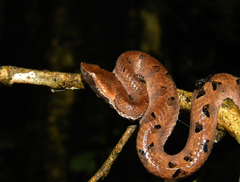
Hypnale hypnale is a venomous pit viper species endemic to India and Sri Lanka. Common names include the hump-nosed viper, Merrem's hump-nosed viper hump-nosed pit viper, and Oriental hump-nosed viper. No subspecies are currently recognized.

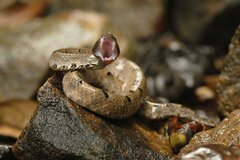
H. hypnale grows to an average of 30 to 45 cm (12 to 18 in) in total length (including tail). The Armed Forces Pest Management Board states 0.4 to 0.6 m (1 ft 4 in to 2 ft 0 in) in total length. Its build is that of a typical viperid with a stout body and a wide head. The snout is pointed and turned upwards, ending in a hump. The frontal, supraoculars, and parietal shields are large, but those on the snout are small and irregular.

The color pattern is grayish with heavy brown mottling, overlaid with a double row of large dark spots. The belly is brownish or yellowish with dark mottling. The tip of the tail is yellow or reddish. Hypnale hypnale is found in peninsular India to the Western Ghats as far north as 16° N, and in Sri Lanka, according to M.A. Smith (1943). The type locality given is "Castle Rock, Karnataka, India." Hypnale hypnale is found in dense jungle and coffee plantations in... Wikipedia →

Global Distribution

Parks Where Found

# Park Country Daily sighting probability
1 Minneriya National Park 🇱🇰 Sri Lanka
~20%

More parks will be added in future updates.

Cities Where Found

# City Country Daily sighting probability
1 Colombo [Sri Jayawardenepura Kotte] 🇱🇰 Sri Lanka
~10%

Closest Relatives at Minneriya National Park

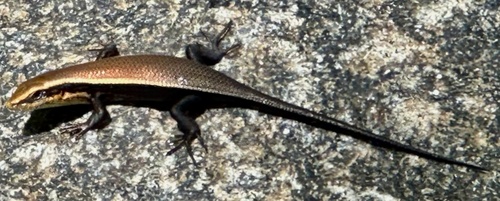
No species of the same family or order lives in Minneriya National Park, so these are its closest relatives here: other reptiles.

Before you go

What are the chances of seeing a Hump-nosed Viper in Minneriya National Park?

Possible

About 20% of wildlife watchers report a Hump-nosed Viper sighting in Minneriya National Park on a given day, based on 7 verified sightings from GBIF citizen-science data from 2019 to 2026. It is the 17th most-seen of the 19 reptiles we can rate there. Over three days the chance rises to about 40%, and over a week to about 70%, if each day is a fresh chance.

When is the best time to see a Hump-nosed Viper in Minneriya National Park?

February, April and November

In those months about 30% of wildlife watchers report a Hump-nosed Viper in Minneriya National Park on a given day, against under 5% in May–October and December–January, the lowest months.

What time of day is best to see a Hump-nosed Viper?

Between 7 and 10 pm

Across all the parks we cover, that three-hour window holds the most Hump-nosed Viper sightings with a recorded time, and about 6 in 10 of them come between 6 pm and 6 am: it is seen both by day and at night.

Where else can you see a Hump-nosed Viper?

Only Minneriya National Park, in our data

Minneriya National Park is the only park on Wallace's Line with enough records to rate Hump-nosed Viper sightings: about 20% of wildlife watchers there report one on a given day.

Where does the Hump-nosed Viper sighting chance come from?

GBIF citizen-science records

It is estimated from how often the Hump-nosed Viper is recorded against all the reptiles logged in Minneriya National Park (7 verified sightings from 2019 to 2026), calibrated against known sighting rates. Figures are rounded to the nearest 10% because citizen-science data supports honest approximations, not decimals, and months with records from fewer than five people show "—". How it works.

← Back to Minneriya National Park