White-headed Mousebird

White-headed Mousebird

Colius leucocephalus

Silhouette: Enoch Joseph Wetsy (photo), John E. McCormack, Michael G. Harvey, Brant C. Faircloth, Nicholas G. Crawford, Travis C. Glenn, Robb T. Brumfield & T. Michael Keesey · PhyloPic

LCLeast ConcernNTVUENCR
Daily sighting probability ~20% · Possible
at Mkomazi National Park

In 3 days ~40% in a week ~70%

25 Verified sightings at Mkomazi National Park From 2019 to 2026
618 In all 7 parks
September Best month
☀️ Diurnal When it's spotted

About the White-headed Mousebird

The white-headed mousebird (Colius leucocephalus) is a bird belonging to the mousebird family, Coliidae. It is found only in east Africa where it occurs in southern Somalia and parts of Kenya with its range just extending into southern Ethiopia and northern Tanzania. It inhabits arid bushland up to 1,400 metres above sea-level.

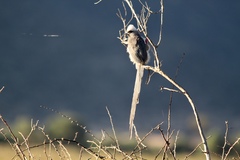
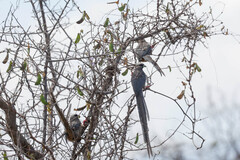
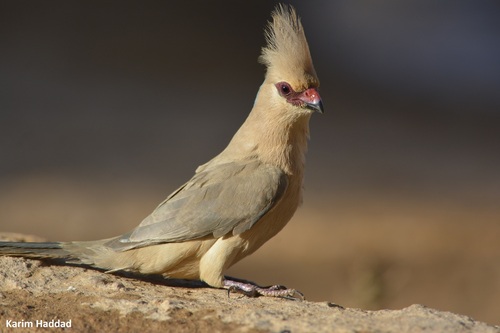
It is 32 cm long with the long, graduated tail accounting for over half of this. The plumage is mainly greyish with black and white barring on the back, neck and breast. It has a white crest, crown and cheeks. There is a white stripe down the back which becomes visible when the bird flies. Around the eye is a patch of dark, bare skin. The bill is bluish-white above and buff below. In juvenile birds, the throat and breast are buff.

The contact call is a scratchy chattering and the bird also has a descending song. Sinclair, Ian & Ryan, Peter (2003) Birds of Africa south of the Sahara, Struik, Cape Town. Zimmerman, Dale A.; Turner, Donald A. & Pearson, David J. (1999) Birds of Kenya & Northern Tanzania, Christopher Helm, London. Wikipedia →

Sounds

Call0:17

Kenya · 2024

© Peter Boesman · XC948108 · CC BY-NC-ND 4.0

Call0:11

Kenya · 2023

© Brendan Sloan · XC795072 · CC BY-NC-ND 4.0

Call0:10

Tanzania · 2017

© Frank Lambert · XC449351 · CC BY-NC-ND 4.0

Global Distribution

Parks Where Found

# Park Country Daily sighting probability
1 Samburu National Reserve 🇰🇪 Kenya
~50%
2 Mkomazi National Park 🇹🇿 Tanzania
~20%
3 Amboseli National Park 🇰🇪 Kenya
<5%
4 Tsavo East National Park 🇰🇪 Kenya
<5%
5 Tsavo West National Park 🇰🇪 Kenya
<5%
6 Lake Manyara National Park 🇹🇿 Tanzania
<5%
7 Arusha National Park 🇹🇿 Tanzania
<5%

Zoos & Centres Where Found

# Zoo / Centre Country
1 North Carolina Zoo 🇺🇸 United States In captivity

Before you go

What are the chances of seeing a White-headed Mousebird in Mkomazi National Park?

Possible

About 20% of wildlife watchers report a White-headed Mousebird sighting in Mkomazi National Park on a given day, based on 25 verified sightings from GBIF citizen-science data from 2019 to 2026. It is the 127th most-seen of the 272 birds we can rate there. Over three days the chance rises to about 40%, and over a week to about 70%, if each day is a fresh chance.

When is the best time to see a White-headed Mousebird in Mkomazi National Park?

September

In that month about 40% of wildlife watchers report a White-headed Mousebird in Mkomazi National Park on a given day, against under 5% in November, the lowest month. That is one of Mkomazi National Park's driest months, with about 20 mm of rain against 150 mm in December. May has too few records to rate.

What time of day is best to see a White-headed Mousebird?

Between 7 and 10 am

Across all the parks we cover, that three-hour window holds the most White-headed Mousebird sightings with a recorded time, and about 9 in 10 of them come between 6 am and 6 pm: it is a daytime animal.

Is Mkomazi National Park the best place to see a White-headed Mousebird?

2nd of 7

Of the 7 parks where we can rate White-headed Mousebird sightings, Mkomazi National Park ranks 2nd at about 20%. The best odds are in Samburu National Reserve (Kenya, about 50%).

Where does the White-headed Mousebird sighting chance come from?

GBIF citizen-science records

It is estimated from how often the White-headed Mousebird is recorded against all the birds logged in Mkomazi National Park (25 verified sightings from 2019 to 2026), calibrated against known sighting rates. Figures are rounded to the nearest 10% because citizen-science data supports honest approximations, not decimals, and months with records from fewer than five people show "—". How it works.

← Back to Mkomazi National Park