Blackcap Babbler

Blackcap Babbler

Turdoides reinwardtii

Silhouette: Sheatherius · PhyloPic

LCLeast ConcernNTVUENCR
Daily sighting probability ~20% · Possible
at Mole National Park

In 3 days ~40% in a week ~70%

63 Verified sightings at Mole National Park From 2019 to 2026
234 In all 2 parks
May Best month
☀️ Diurnal When it's spotted

About the Blackcap Babbler

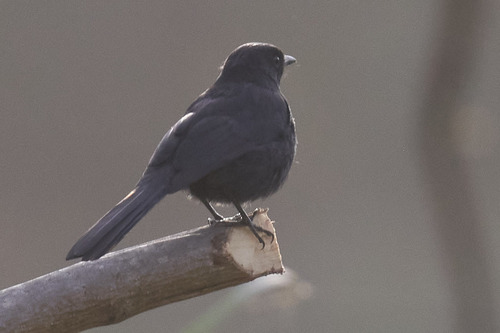
The blackcap babbler (Turdoides reinwardtii) is a member of the family Leiothrichidae. The blackcap babbler is a common resident breeding bird in west Africa from Senegal to Cameroon. Its habitat is thick scrub and forest. This species, like most babblers, is not migratory, and has short rounded wings and a weak flight.

It builds its cup-shaped nest in a tree, concealed in dense masses of foliage. The normal clutch is two or three eggs. These birds have dark grey-brown upperparts. The head is brownish black with a white throat and conspicuous white eye ring. The underparts are white, mottled on the breast and with buff flanks.

The blackcap babbler lives in flocks of four to twelve or more, which help to raise the young communally. It is a noisy bird, and the presence of a flock may generally be known at some distance by the continual chattering, squeaking and chirping produced by its members. The main call is a cha-ka-ta. It feeds mainly on insects, but also eats fruit.

The binomial commemorates the botanist Caspar Georg Carl Reinwardt. Birds of The Gambia by Barlow, Wacher and Disley, ISBN 1-873403-32-1 Collar, N. J. & Robson, C. 2007. Family Timaliidae (Babblers...

Wikipedia →

Sounds

Call1:30

Senegal · 2026

© Peter Boesman · XC1081445 · CC BY-NC-ND 4.0

Duet1:02

Niger · 2018

© Étienne Leroy · XC928469 · CC BY-NC-SA 4.0

Alarm call0:41

Gambia · 2021

© Joost van Bruggen · XC690026 · CC BY-NC-ND 4.0

Global Distribution

Parks Where Found

# Park Country Daily sighting probability
1 Niokolo-Koba National Park 🇸🇳 Senegal
~40%
2 Mole National Park 🇬🇭 Ghana
~20%

Cities Where Found

# City Country Daily sighting probability
1 Serrekunda 🇬🇲 Gambia
~30%
2 Accra 🇬🇭 Ghana
~10%
3 Ouagadougou 🇧🇫 Burkina Faso
~10%

Before you go

What are the chances of seeing a Blackcap Babbler in Mole National Park?

Possible

About 20% of wildlife watchers report a Blackcap Babbler sighting in Mole National Park on a given day, based on 63 verified sightings from GBIF citizen-science data from 2019 to 2026. It is the 124th most-seen of the 266 birds we can rate there. Over three days the chance rises to about 40%, and over a week to about 70%, if each day is a fresh chance.

When is the best time to see a Blackcap Babbler in Mole National Park?

October and December–June

In those months about 20% of wildlife watchers report a Blackcap Babbler in Mole National Park on a given day, against about 10% in August–September and November, the lowest months. July has too few records to rate.

What time of day is best to see a Blackcap Babbler?

Between 8 and 11 am

Across all the parks we cover, that three-hour window holds the most Blackcap Babbler sightings with a recorded time, and about 8 in 10 of them come between 6 am and 6 pm: it is a daytime animal.

Is Mole National Park the best place to see a Blackcap Babbler?

2nd of 2

Of the 2 parks where we can rate Blackcap Babbler sightings, Mole National Park ranks 2nd at about 20%. The best odds are in Niokolo-Koba National Park (Senegal, about 40%).

Where does the Blackcap Babbler sighting chance come from?

GBIF citizen-science records

It is estimated from how often the Blackcap Babbler is recorded against all the birds logged in Mole National Park (63 verified sightings from 2019 to 2026), calibrated against known sighting rates. Figures are rounded to the nearest 10% because citizen-science data supports honest approximations, not decimals, and months with records from fewer than five people show "—". How it works.

← Back to Mole National Park