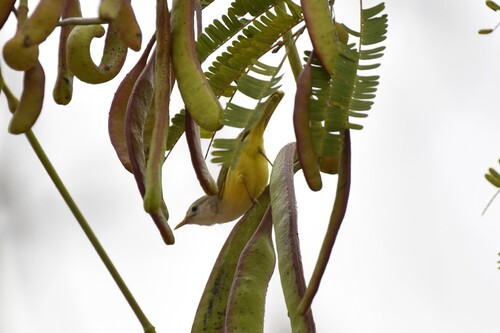
Dorst's Cisticola

Dorst's Cisticola

Cisticola guinea

LCLeast ConcernNTVUENCR
Daily sighting probability ~20% · Possible
at Mole National Park

In 3 days ~40% in a week ~70%

68 Verified sightings at Mole National Park From 2019 to 2026
68 In 1 park
January Best month

About the Dorst's Cisticola

Dorst's cisticola (Cisticola guinea), also known as the plaintive cisticola, is a bird in the family Cisticolidae. It occurs in West Africa and south of Lake Chad. Taxonomy and systematics of this bird are quite confusing. The Cisticolidae were formerly included in the "Old World warbler" assemblage and placed in the family Sylviidae. Dorst's cisticola was initially named Cisticola dorsti, hence the common name. The name commemorates the French ornithologist Jean Dorst.

Another very similar cisticola had been described some years earlier as a subspecies of the red-pate cisticola (C. ruficeps), and named C. r. guinea. It was eventually discovered that these two taxa were one and the same, and that the song of these birds differs enough from the visually very similar red-pate cisticola for reproductive isolation. Thus, the newly discovered population is usually considered a good species, and the current scientific name is Cisticola guinea, although other taxonomists continue to use dorsti.

Its natural habitat is dry savanna. This little-known bird was formerly classified as data deficient by the IUCN, mainly due to the uncertainty regarding its taxonomic status. New research has shown it to be plentiful and widespread. Consequently, it is listed as a species of least concern in 2008.

Wikipedia →

Sounds

Song1:02

Ghana · 2022

© Peter Boesman · XC719031 · CC BY-NC-ND 4.0

Song1:11

Ghana · 2022

© Phil Gregory · XC718049 · CC BY-NC-SA 4.0

Global Distribution

Parks Where Found

# Park Country Daily sighting probability
1 Mole National Park 🇬🇭 Ghana
~20%

More parks will be added in future updates.

Before you go

What are the chances of seeing a Dorst's Cisticola in Mole National Park?

Possible

About 20% of wildlife watchers report a Dorst's Cisticola sighting in Mole National Park on a given day, based on 68 verified sightings from GBIF citizen-science data from 2019 to 2026. It is the 127th most-seen of the 266 birds we can rate there. Over three days the chance rises to about 40%, and over a week to about 70%, if each day is a fresh chance.

When is the best time to see a Dorst's Cisticola in Mole National Park?

January

In that month about 30% of wildlife watchers report a Dorst's Cisticola in Mole National Park on a given day, against about 10% in February–March, May and September, the lowest months. That is one of Mole National Park's driest months, with almost no rain against 220 mm in August. July has too few records to rate.

Where else can you see a Dorst's Cisticola?

Only Mole National Park, in our data

Mole National Park is the only park on Wallace's Line with enough records to rate Dorst's Cisticola sightings: about 20% of wildlife watchers there report one on a given day.

Which relatives of the Dorst's Cisticola live in Mole National Park?

Same genus: Cisticola

The closest relatives of the Dorst's Cisticola that you can see in Mole National Park (genus Cisticola, Cisticolas) are Rufous Cisticola (about 20%), Singing Cisticola (about 20%) and Rock-loving Cisticola (about 10%), with each one's daily chance of a sighting.

Where does the Dorst's Cisticola sighting chance come from?

GBIF citizen-science records

It is estimated from how often the Dorst's Cisticola is recorded against all the birds logged in Mole National Park (68 verified sightings from 2019 to 2026), calibrated against known sighting rates. Figures are rounded to the nearest 10% because citizen-science data supports honest approximations, not decimals, and months with records from fewer than five people show "—". How it works.

← Back to Mole National Park