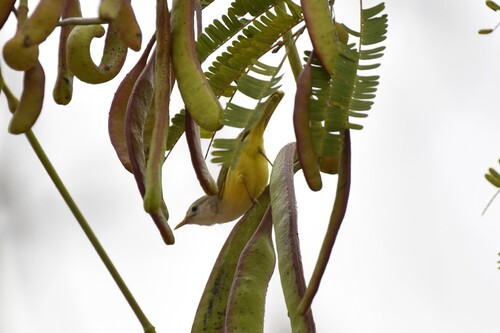
Whistling Cisticola

Whistling Cisticola

Cisticola lateralis

Silhouette: Sheatherius · PhyloPic

LCLeast ConcernNTVUENCR
Daily sighting probability <5% · Rare
at Mole National Park

In 3 days ~10%

8 Verified sightings at Mole National Park From 2019 to 2026
143 In all 4 parks
August Best month
☀️ Diurnal When it's spotted

About the Whistling Cisticola

The whistling cisticola (Cisticola lateralis) is a species of bird in the Cisticolidae family. It is native to the African tropical rainforest and adjacent areas. Its natural habitats include subtropical or tropical dry forests, dry savanna, and moist savanna.

The whistling cisticola was formally described in 1843 by the British zoologist and collector Louis Fraser under the binomial name Drymoica lateralis based on a specimen collected near Cape Palmas in the south of Liberia. The specific epithet lateralis is Latin meaning "of the side" or "lateral". The whistling cisticola is now one of 53 species placed in the genus Cisticola that was introduced in 1829 by the German naturalist Johann Jakob Kaup.

Three subspecies are recognised: The whistling cisticola is a mid-sized bird that has a body length of 13–16 cm with a male weight of 14-21 grams, and female weight of 12-19 grams. A breeding, male cisticola is described to...

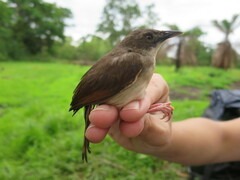
Wikipedia →

Sounds

Call0:26

Ivory Coast · 2026

© Étienne Leroy · XC1186474 · CC BY-NC-SA 4.0

Song0:32

Congo (Democratic Republic) · 2025

© Bram Piot · XC1063934 · CC BY-NC-SA 4.0

Song0:21

Ghana · 2022

© Peter Boesman · XC719040 · CC BY-NC-ND 4.0

Global Distribution

Parks Where Found

# Park Country Daily sighting probability
1 Kakum National Park 🇬🇭 Ghana
~20%
2 Murchison Falls National Park 🇺🇬 Uganda
<5%
3 Mole National Park 🇬🇭 Ghana
<5%
4 Lake Mburo National Park 🇺🇬 Uganda
<5%

Cities Where Found

# City Country Daily sighting probability
1 Freetown 🇸🇱 Sierra Leone
~10%
2 Kampala 🇺🇬 Uganda
<5%

Before you go

What are the chances of seeing a Whistling Cisticola in Mole National Park?

Rare

Under 5% of wildlife watchers report a Whistling Cisticola sighting in Mole National Park on a given day, based on 8 verified sightings from GBIF citizen-science data from 2019 to 2026. It is the 242nd most-seen of the 266 birds we can rate there. Over three days the chance rises to about 10%, if each day is a fresh chance.

When is the best time to see a Whistling Cisticola in Mole National Park?

June, August and October

In those months about 10% of wildlife watchers report a Whistling Cisticola in Mole National Park on a given day, against under 5% in September and November–May, the lowest months. Those are among Mole National Park's wettest months, with about 140 mm of rain a month against almost none in January. July has too few records to rate.

What time of day is best to see a Whistling Cisticola?

Between 7 and 10 am

Across all the parks we cover, that three-hour window holds the most Whistling Cisticola sightings with a recorded time, and about 9 in 10 of them come between 6 am and 6 pm: it is a daytime animal.

Is Mole National Park the best place to see a Whistling Cisticola?

3rd of 4

Of the 4 parks where we can rate Whistling Cisticola sightings, Mole National Park ranks 3rd at under 5%. The best odds are in Kakum National Park (Ghana, about 20%) and Murchison Falls National Park (Uganda, under 5%).

Which relatives of the Whistling Cisticola live in Mole National Park?

Same genus: Cisticola

The closest relatives of the Whistling Cisticola that you can see in Mole National Park (genus Cisticola, Cisticolas) are Rufous Cisticola (about 20%), Singing Cisticola (about 20%) and Dorst's Cisticola (about 20%), with each one's daily chance of a sighting.

Where does the Whistling Cisticola sighting chance come from?

GBIF citizen-science records

It is estimated from how often the Whistling Cisticola is recorded against all the birds logged in Mole National Park (8 verified sightings from 2019 to 2026), calibrated against known sighting rates. Figures are rounded to the nearest 10% because citizen-science data supports honest approximations, not decimals, and months with records from fewer than five people show "—". How it works.

← Back to Mole National Park