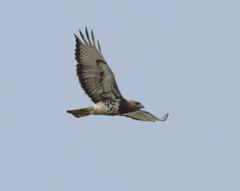
Red-necked Buzzard

Red-necked Buzzard

Buteo auguralis

Silhouette: Lauren Anderson · PhyloPic

LCLeast ConcernNTVUENCR
Daily sighting probability ~20% · Possible
at Mole National Park

In 3 days ~40% in a week ~70%

64 Verified sightings at Mole National Park From 2019 to 2026
127 In all 3 parks
January Best month
☀️ Diurnal When it's spotted

About the Red-necked Buzzard

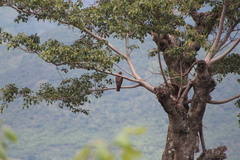
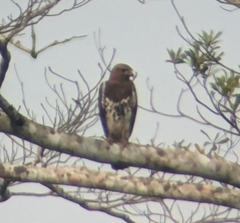
The red-necked buzzard (Buteo auguralis), also known as the African red-tailed buzzard, is a species of buzzard in the family Accipitridae which is found in western and northern central Africa. The red-necked buzzard is a medium-sized bird of prey with a distinctive rufous neck, the rufous colour extends up over the crown and down on to the upper back. The rest of the upperparts are mostly blackish, except for the rufous upper tail feathers which has a black subterminal bar. The underparts are mainly white, apart from a dark throat and dark blotches which extend along the flanks. Juveniles resemble the adults, but have a browner upperparts, creamy rather than white underparts and lack the dark throat.

The red-necked buzzard occurs in a broad band running from Mauritania south to Liberia then eastwards to Ethiopia and Uganda, as well as south along the Gulf of Guinea coast through Gabon to the Democratic Republic of Congo and north-eastern Angola.

The red-necked buzzard is a partial migrant, the northern populations may be completely migrant which leave the savanna following the rains and spend the dry season to the south along the edge...

Wikipedia →

Sounds

Call0:08

Cameroon · 2016

© Paweł Szymański · XC383298 · CC BY-NC-SA 4.0

Global Distribution

Parks Where Found

# Park Country Daily sighting probability
1 Chinko Conservation Area 🇨🇫 Central African Republic
~20%
2 Mole National Park 🇬🇭 Ghana
~20%
3 Kakum National Park 🇬🇭 Ghana
~10%

Cities Where Found

# City Country Daily sighting probability
1 Freetown 🇸🇱 Sierra Leone
~10%

Before you go

What are the chances of seeing a Red-necked Buzzard in Mole National Park?

Possible

About 20% of wildlife watchers report a Red-necked Buzzard sighting in Mole National Park on a given day, based on 64 verified sightings from GBIF citizen-science data from 2019 to 2026. It is the 132nd most-seen of the 266 birds we can rate there. Over three days the chance rises to about 40%, and over a week to about 70%, if each day is a fresh chance.

When is the best time to see a Red-necked Buzzard in Mole National Park?

January

In that month about 40% of wildlife watchers report a Red-necked Buzzard in Mole National Park on a given day, against under 5% in October, the lowest month. That is one of Mole National Park's driest months, with almost no rain against 220 mm in August. July has too few records to rate.

What time of day is best to see a Red-necked Buzzard?

Between 8 and 11 am

Across all the parks we cover, that three-hour window holds the most Red-necked Buzzard sightings with a recorded time, and about 8 in 10 of them come between 6 am and 6 pm: it is a daytime animal.

Is Mole National Park the best place to see a Red-necked Buzzard?

Among the best

Of the 3 parks where we can rate Red-necked Buzzard sightings, Mole National Park ranks 2nd at about 20%, level with the leaders once rounded. The best odds are in Chinko Conservation Area (Central African Republic, about 20%).

Which relatives of the Red-necked Buzzard live in Mole National Park?

Same family: Accipitridae

The closest relatives of the Red-necked Buzzard that you can see in Mole National Park (family Accipitridae, Hawks, Eagles, and Kites) are Bateleur (about 60%), Hooded Vulture (about 60%) and Black Kite (about 50%), with each one's daily chance of a sighting.

Where does the Red-necked Buzzard sighting chance come from?

GBIF citizen-science records

It is estimated from how often the Red-necked Buzzard is recorded against all the birds logged in Mole National Park (64 verified sightings from 2019 to 2026), calibrated against known sighting rates. Figures are rounded to the nearest 10% because citizen-science data supports honest approximations, not decimals, and months with records from fewer than five people show "—". How it works.

← Back to Mole National Park