
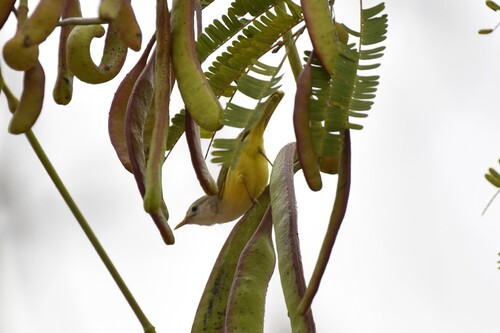
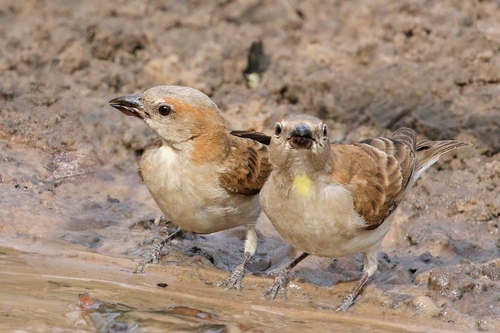
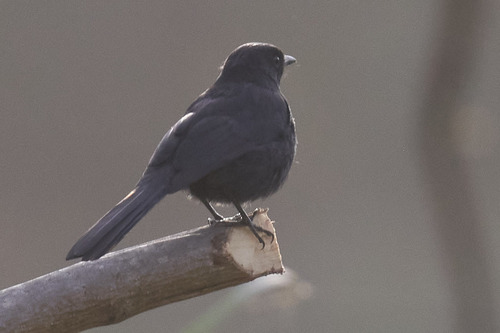
Western Violet-backed Sunbird

Western Violet-backed Sunbird

Anthreptes longuemarei

Silhouette: Sheatherius · PhyloPic

LCLeast ConcernNTVUENCR
Daily sighting probability ~10% · With luck
at Mole National Park

In 3 days ~40% in a week ~60%

53 Verified sightings at Mole National Park From 2019 to 2026
132 In all 6 parks
November Best month
☀️ Diurnal When it's spotted

About the Western Violet-backed Sunbird

The western violet-backed sunbird or Longuemare's sunbird (Anthreptes longuemarei) is a species of bird in the family Nectariniidae. It is the most widely ranging species in the violet-backed sunbird superspecies, ranging throughout a large part of tropical mainland sub-Saharan Africa not inhabited by other members of the superspecies. It is mainly found in regions with mesic woodland.

(Western) violet-backed sunbird - Species text in The Atlas of Southern African Birds.

Wikipedia →

Sounds

Call0:27

Zambia · 2020

© Dries Van de Loock · XC584726 · CC BY-NC-SA 4.0

Song1:10

Zambia · 2016

© Peter Boesman · XC338919 · CC BY-NC-ND 4.0

Call0:34

Senegal · 2018

© Bram Piot · XC407028 · CC BY-NC-SA 4.0

Global Distribution

Parks Where Found

# Park Country Daily sighting probability
1 Mole National Park 🇬🇭 Ghana
~10%
2 Niokolo-Koba National Park 🇸🇳 Senegal
~10%
3 Mikumi National Park 🇹🇿 Tanzania
~10%
4 Ruaha National Park 🇹🇿 Tanzania
<5%
5 Murchison Falls National Park 🇺🇬 Uganda
<5%
6 Kafue National Park 🇿🇲 Zambia
<5%

Before you go

What are the chances of seeing a Western Violet-backed Sunbird in Mole National Park?

With luck

About 10% of wildlife watchers report a Western Violet-backed Sunbird sighting in Mole National Park on a given day, based on 53 verified sightings from GBIF citizen-science data from 2019 to 2026. It is the 147th most-seen of the 266 birds we can rate there. Over three days the chance rises to about 40%, and over a week to about 60%, if each day is a fresh chance.

When is the best time to see a Western Violet-backed Sunbird in Mole National Park?

May and August–November

In those months about 20% of wildlife watchers report a Western Violet-backed Sunbird in Mole National Park on a given day, against about 10% in June and December–April, the lowest months. Those are among Mole National Park's wettest months, with about 110 mm of rain a month against almost none in January. July has too few records to rate.

What time of day is best to see a Western Violet-backed Sunbird?

Between 7 and 10 am

Across all the parks we cover, that three-hour window holds the most Western Violet-backed Sunbird sightings with a recorded time, and about 9 in 10 of them come between 6 am and 6 pm: it is a daytime animal.

Is Mole National Park the best place to see a Western Violet-backed Sunbird?

Yes

Of the 6 parks where we can rate Western Violet-backed Sunbird sightings, Mole National Park has the highest daily chance: about 10%. Next come Niokolo-Koba National Park (Senegal, about 10%) and Mikumi National Park (Tanzania, about 10%).

Which relatives of the Western Violet-backed Sunbird live in Mole National Park?

Same family: Nectariniidae

The closest relatives of the Western Violet-backed Sunbird that you can see in Mole National Park (family Nectariniidae, Sunbirds and Spiderhunters) are Scarlet-chested Sunbird (about 70%), Pygmy Sunbird (about 50%) and Beautiful Sunbird (about 50%), with each one's daily chance of a sighting.

Where does the Western Violet-backed Sunbird sighting chance come from?

GBIF citizen-science records

It is estimated from how often the Western Violet-backed Sunbird is recorded against all the birds logged in Mole National Park (53 verified sightings from 2019 to 2026), calibrated against known sighting rates. Figures are rounded to the nearest 10% because citizen-science data supports honest approximations, not decimals, and months with records from fewer than five people show "—". How it works.

← Back to Mole National Park