Sumichrast's Vesper Rat

Sumichrast's Vesper Rat

Nyctomys sumichrasti

Silhouette: T. Michael Keesey · PhyloPic

LCLeast ConcernNTVUENCR
Daily sighting probability ~10% · With luck
at Monteverde Cloud Forest Reserve

In 3 days ~20% in a week ~30%

6 Verified sightings at Monteverde Cloud Forest Reserve From 2019 to 2026
25 In all 3 parks
October Best month
🌙 Nocturnal When it's spotted

About the Sumichrast's Vesper Rat

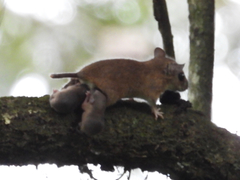
Sumichrast's vesper rat (Nyctomys sumichrasti) is a rodent of the family Cricetidae found from southern Mexico to Panama. It is named for François Sumichrast, the collector of the first specimen, and its closest relative is probably Hatt's vesper rat, a similar, but slightly smaller, species from the Yucatán Peninsula.

Sumichrast's vesper rat is a relatively small rat, with an adult length of 10 to 13 cm (3.9 to 5.1 in), not including the tail, which is only slightly shorter. Males and females are of similar size, with both weighing between 220 to 245 g (7.8 to 8.6 oz). It is one of the more brightly coloured rats, with a reddish or orange back and creamy to white underparts. The rats have a thick pelt of soft fur, which extends over the entire length of the tail, and is absent only on the soles of the feet. The eyes are relatively large, and surrounded by a narrow ring of black hair, while the whiskers are long and the ears small.

To aid in climbing, the claws are compressed and curved, and the first toe on each foot is thumb-like. Sumichrast's vesper rat is found from southern Jalisco and Veracruz in Mexico through much of Central... Wikipedia →

Global Distribution

Parks Where Found

# Park Country Daily sighting probability
1 Braulio Carrillo National Park 🇨🇷 Costa Rica
~10%
2 Arenal Volcano National Park 🇨🇷 Costa Rica
~10%
3 Monteverde Cloud Forest Reserve 🇨🇷 Costa Rica
~10%

Before you go

What are the chances of seeing a Sumichrast's Vesper Rat in Monteverde Cloud Forest Reserve?

With luck

About 10% of wildlife watchers report a Sumichrast's Vesper Rat sighting in Monteverde Cloud Forest Reserve on a given day, based on 6 verified sightings from GBIF citizen-science data from 2019 to 2026. It is the 21st most-seen of the 28 mammals we can rate there. Over three days the chance rises to about 20%, and over a week to about 30%, if each day is a fresh chance.

When is the best time to see a Sumichrast's Vesper Rat in Monteverde Cloud Forest Reserve?

March–May, August and October

In those months about 10% of wildlife watchers report a Sumichrast's Vesper Rat in Monteverde Cloud Forest Reserve on a given day, against under 5% in June–July, September and November–February, the lowest months.

What time of day is best to see a Sumichrast's Vesper Rat?

Between 7 and 10 pm

Across all the parks we cover, that three-hour window holds the most Sumichrast's Vesper Rat sightings with a recorded time, and about 7 in 10 of them come between 6 pm and 6 am: it is mostly seen at night.

Is Monteverde Cloud Forest Reserve the best place to see a Sumichrast's Vesper Rat?

Among the best

Of the 3 parks where we can rate Sumichrast's Vesper Rat sightings, Monteverde Cloud Forest Reserve ranks 3rd at about 10%, level with the leaders once rounded. The best odds are in Braulio Carrillo National Park (Costa Rica, about 10%) and Arenal Volcano National Park (Costa Rica, about 10%).

Which relatives of the Sumichrast's Vesper Rat live in Monteverde Cloud Forest Reserve?

Same family: Cricetidae

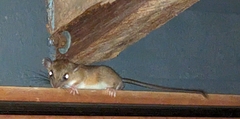
The closest relatives of the Sumichrast's Vesper Rat that you can see in Monteverde Cloud Forest Reserve (family Cricetidae, Hamsters, Voles, Lemmings, and Allies) are Watson's climbing rat (about 10%) and Mexican Deer Mouse (about 10%), with each one's daily chance of a sighting.

Where does the Sumichrast's Vesper Rat sighting chance come from?

GBIF citizen-science records

It is estimated from how often the Sumichrast's Vesper Rat is recorded against all the mammals logged in Monteverde Cloud Forest Reserve (6 verified sightings from 2019 to 2026), calibrated against known sighting rates. Figures are rounded to the nearest 10% because citizen-science data supports honest approximations, not decimals, and months with records from fewer than five people show "—". How it works.

← Back to Monteverde Cloud Forest Reserve