Black-billed Wood-Dove

Black-billed Wood-Dove

Turtur abyssinicus

Silhouette: Sheatherius · PhyloPic

LCLeast ConcernNTVUENCR
Daily sighting probability ~40% · Likely
at Murchison Falls National Park

In 3 days ~80% in a week >90%

506 Verified sightings at Murchison Falls National Park From 2019 to 2026
921 In all 4 parks
July Best month
☀️ Diurnal When it's spotted

About the Black-billed Wood-Dove

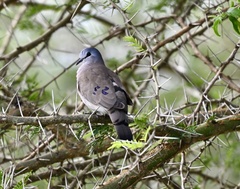
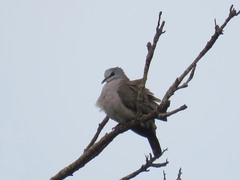
The black-billed wood dove or black-billed dove (Turtur abyssinicus) is a pigeon which is a widespread resident breeding bird in a belt across Africa just south of the Sahara Desert. This species is abundant in near desert, scrub and savannah. It builds a stick nest in a tree, often an acacia, and lays two cream-colored eggs. Its flight is quick, with the regular beats and an occasional sharp flick of the wings which are characteristic of pigeons in general, and it tends to stay quite low.

Black-billed wood dove is a small plump pigeon, typically 20 cm in length. Its back, hindneck, wings and tail are pale grey brown, and the folded wings have dark metallic patches. There are two blackish bands on the back. The forehead, crown and nape are bluish grey, fading to whitish on the face. The underparts are pinkish, becoming whiter on the belly.

The bill of this dove is black. When flying, black-billed wood dove shows chestnut in the underwing. The call is a persistent fluted coo-coo-cu-coo. Sexes are similar, but immatures are duller than adults, scaly below, and lack the wing spots.

Black-billed wood doves eat grass and other small seeds. They are quite terrestrial, and usually forage on the ground. They are not very gregarious, but form large flocks at waterholes. Though they are classified as Least Concern in the IUCN, their population has decreased significantly since 2004. Wikipedia →

Sounds

Song0:43

Gambia · 2025

© Romuald Mikusek · XC1041583 · CC BY-NC-SA 4.0

Call0:09

Ghana · 2016

© Phil Gregory · XC310317 · CC BY-NC-SA 4.0

Song0:12

Ethiopia · 2014

© Andrew Spencer · XC277698 · CC BY-NC-ND 4.0

Global Distribution

Parks Where Found

# Park Country Daily sighting probability
1 Niokolo-Koba National Park 🇸🇳 Senegal
~80%
2 Murchison Falls National Park 🇺🇬 Uganda
~40%
3 Kidepo Valley National Park 🇺🇬 Uganda
~20%
4 Queen Elizabeth National Park 🇺🇬 Uganda
<5%

Cities Where Found

# City Country Daily sighting probability
1 Ouagadougou 🇧🇫 Burkina Faso
~30%
2 Serrekunda 🇬🇲 Gambia
~10%
3 Abuja 🇳🇬 Nigeria
<5%

Before you go

What are the chances of seeing a Black-billed Wood-Dove in Murchison Falls National Park?

Likely

About 40% of wildlife watchers report a Black-billed Wood-Dove sighting in Murchison Falls National Park on a given day, based on 506 verified sightings from GBIF citizen-science data from 2019 to 2026. It is the 30th most-seen of the 424 birds we can rate there. Over three days the chance rises to about 80%, and over a week to over 90%, if each day is a fresh chance.

When is the best time to see a Black-billed Wood-Dove in Murchison Falls National Park?

February and June–July

In those months about 50% of wildlife watchers report a Black-billed Wood-Dove in Murchison Falls National Park on a given day, against about 20% in May, the lowest month.

What time of day is best to see a Black-billed Wood-Dove?

Between 10 am and 1 pm

Across all the parks we cover, that three-hour window holds the most Black-billed Wood-Dove sightings with a recorded time, and about 8 in 10 of them come between 6 am and 6 pm: it is a daytime animal.

Is Murchison Falls National Park the best place to see a Black-billed Wood-Dove?

2nd of 4

Of the 4 parks where we can rate Black-billed Wood-Dove sightings, Murchison Falls National Park ranks 2nd at about 40%. The best odds are in Niokolo-Koba National Park (Senegal, about 80%).

Which relatives of the Black-billed Wood-Dove live in Murchison Falls National Park?

Same genus: Turtur

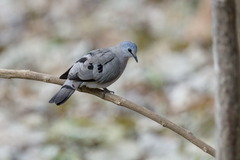
The closest relatives of the Black-billed Wood-Dove that you can see in Murchison Falls National Park (genus Turtur, Wood-Doves) are Blue-spotted Wood-Dove (about 20%) and Tambourine Dove (about 10%), with each one's daily chance of a sighting.

Where does the Black-billed Wood-Dove sighting chance come from?

GBIF citizen-science records

It is estimated from how often the Black-billed Wood-Dove is recorded against all the birds logged in Murchison Falls National Park (506 verified sightings from 2019 to 2026), calibrated against known sighting rates. Figures are rounded to the nearest 10% because citizen-science data supports honest approximations, not decimals, and months with records from fewer than five people show "—". How it works.

← Back to Murchison Falls National Park