Chocolate-backed Kingfisher

Chocolate-backed Kingfisher

Halcyon badia

Silhouette: Andy Wilson · PhyloPic

LCLeast ConcernNTVUENCR
Daily sighting probability <5% · Rare
at Murchison Falls National Park

In 3 days <5%

6 Verified sightings at Murchison Falls National Park From 2019 to 2026
84 In all 3 parks
July Best month
☀️ Diurnal When it's spotted

About the Chocolate-backed Kingfisher

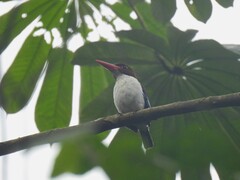
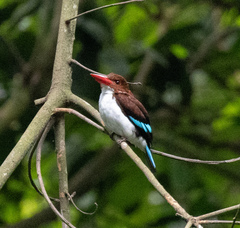
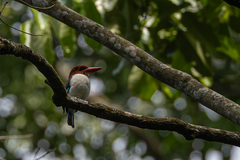
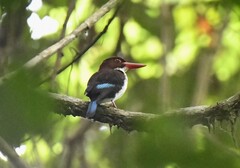
The chocolate-backed kingfisher (Halcyon badia) is a species of kingfisher in the subfamily Halcyoninae, native to the African tropical rainforest. The chocolate-backed kingfisher has the typical stocky kingfisher shape with dark upper parts and pure white underparts. The head and hind neck are very dark brown, the mantle is brownish black, the back is black, the rump a brilliant iridescent blue, the upper tail coverts are black, and the tail is pale blue. The wings are dark, apart from a brilliant azure speculum formed in the outer webs of the secondary feathers. The underparts from the throat to the vent are snowy white, apart from a small blackish flank patch, and are clearly demarcated from the dark upper parts. In flight the brilliant blue rump and speculum are distinctive. The bill is red or reddish brown. Juveniles are similar to adults, except that the breast is scalloped and the bill is blackish with an orange tip.

A harsh screeching alarm note is given. The song is a high pitched, barely audible introductory "pee" followed by 12-17 long flutelike pure tones which are evenly spaced and far carrying, lasting 5–7 seconds, and sometimes falling away... Wikipedia →

Sounds

Recording0:10

Gabon · 2022

© BurBenj · XC1120090 · CC BY-NC-SA 4.0

Song0:06

Sierra Leone · 2022

© Brendan Sloan · XC878219 · CC BY-NC-ND 4.0

Call0:45

Ghana · 2018

© Phil Gregory · XC611148 · CC BY-NC-SA 4.0

Global Distribution

Parks Where Found

# Park Country Daily sighting probability
1 Semuliki National Park 🇺🇬 Uganda
~20%
2 Taï National Park 🇨🇮 Ivory Coast
~10%
3 Murchison Falls National Park 🇺🇬 Uganda
<5%

Before you go

What are the chances of seeing a Chocolate-backed Kingfisher in Murchison Falls National Park?

Rare

Under 5% of wildlife watchers report a Chocolate-backed Kingfisher sighting in Murchison Falls National Park on a given day, based on 6 verified sightings from GBIF citizen-science data from 2019 to 2026. It is the 414th most-seen of the 424 birds we can rate there. Over three days the chance rises to under 5%, if each day is a fresh chance.

When is the best time to see a Chocolate-backed Kingfisher in Murchison Falls National Park?

Any time of year

In every month with enough records, under 5% of wildlife watchers report a Chocolate-backed Kingfisher in Murchison Falls National Park on a given day, so our monthly data shows no clear season.

What time of day is best to see a Chocolate-backed Kingfisher?

Between 9 am and noon

Across all the parks we cover, that three-hour window holds the most Chocolate-backed Kingfisher sightings with a recorded time, and about 8 in 10 of them come between 6 am and 6 pm: it is a daytime animal.

Is Murchison Falls National Park the best place to see a Chocolate-backed Kingfisher?

3rd of 3

Of the 3 parks where we can rate Chocolate-backed Kingfisher sightings, Murchison Falls National Park ranks 3rd at under 5%. The best odds are in Semuliki National Park (Uganda, about 20%) and Taï National Park (Ivory Coast, about 10%).

Which relatives of the Chocolate-backed Kingfisher live in Murchison Falls National Park?

Same genus: Halcyon

The closest relatives of the Chocolate-backed Kingfisher that you can see in Murchison Falls National Park (genus Halcyon, Typical Woodland Kingfishers) are Gray-headed Kingfisher (about 60%), Striped Kingfisher (about 30%) and Woodland Kingfisher (about 20%), with each one's daily chance of a sighting.

Where does the Chocolate-backed Kingfisher sighting chance come from?

GBIF citizen-science records

It is estimated from how often the Chocolate-backed Kingfisher is recorded against all the birds logged in Murchison Falls National Park (6 verified sightings from 2019 to 2026), calibrated against known sighting rates. Figures are rounded to the nearest 10% because citizen-science data supports honest approximations, not decimals, and months with records from fewer than five people show "—". How it works.

← Back to Murchison Falls National Park