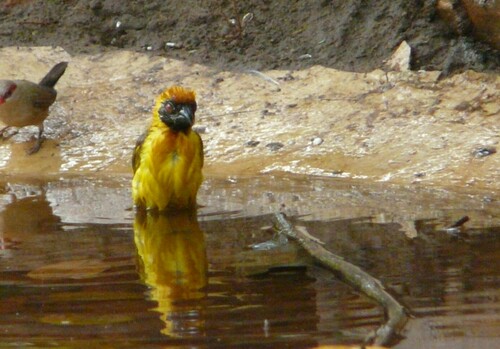
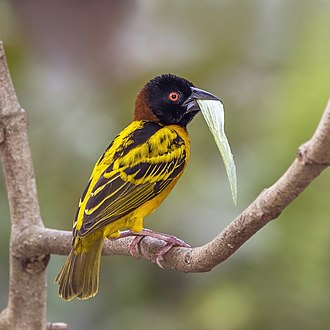
What are the chances of seeing a Compact Weaver in Murchison Falls National Park?
Rare
Under 5% of wildlife watchers report a Compact Weaver sighting in Murchison Falls National Park on a given day, based on 19 verified sightings from GBIF citizen-science data from 2019 to 2026. It is the 304th most-seen of the 424 birds we can rate there. Over three days the chance rises to about 10%, if each day is a fresh chance.
When is the best time to see a Compact Weaver in Murchison Falls National Park?
January
In that month about 10% of wildlife watchers report a Compact Weaver in Murchison Falls National Park on a given day, against under 5% in February to December, the lowest months. That is one of Murchison Falls National Park's driest months, with about 15 mm of rain against 190 mm in October.
What time of day is best to see a Compact Weaver?
Between 7 and 10 am
Across all the parks we cover, that three-hour window holds the most Compact Weaver sightings with a recorded time, and about 9 in 10 of them come between 6 am and 6 pm: it is a daytime animal.
Is Murchison Falls National Park the best place to see a Compact Weaver?
3rd of 4
Of the 4 parks where we can rate Compact Weaver sightings, Murchison Falls National Park ranks 3rd at under 5%. The best odds are in Kibale National Park (Uganda, about 10%) and Queen Elizabeth National Park (Uganda, about 10%).
Which relatives of the Compact Weaver live in Murchison Falls National Park?
Same genus: Ploceus
The closest relatives of the Compact Weaver that you can see in Murchison Falls National Park (genus Ploceus, Typical Weavers) are Black-headed Weaver (about 30%), Little Weaver (about 30%) and Vitelline Masked-Weaver (about 20%), with each one's daily chance of a sighting.
Where does the Compact Weaver sighting chance come from?
GBIF citizen-science records
It is estimated from how often the Compact Weaver is recorded against all the birds logged in Murchison Falls National Park (19 verified sightings from 2019 to 2026), calibrated against known sighting rates. Figures are rounded to the nearest 10% because citizen-science data supports honest approximations, not decimals, and months with records from fewer than five people show "—". How it works.