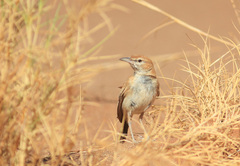
Dune Lark

Dune Lark

Calendulauda erythrochlamys

Silhouette: Gossipguy and T. Michael Keesey · PhyloPic

LCLeast ConcernNTVUENCR
Daily sighting probability ~40% · Likely
at Namib-Naukluft National Park

In 3 days ~80% in a week >90%

300 Verified sightings at Namib-Naukluft National Park From 2019 to 2026
300 In 1 park
December Best month
☀️ Diurnal When it's spotted

About the Dune Lark

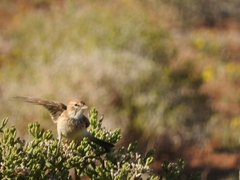
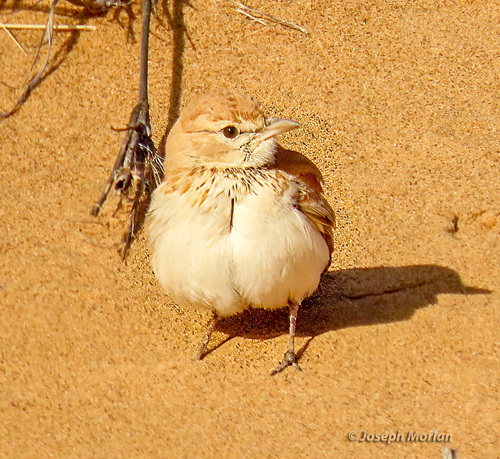
The dune lark (Calendulauda erythrochlamys) is a species of lark in the family Alaudidae. It is Namibia's only endemic bird. Its natural habitat is subtropical or tropical dry lowland grassland. The dune lark is the only avian creature that has evolved the ability to survive in the Namib Desert, which is one of the driest regions in the world.

The dune lark was formally described in 1853 by the English naturalist Hugh Strickland based on specimens collected in Damaraland, a coastal belt near Walvis Bay in Namibia. He coined the binomial name Alauda erythrochlamys. The dune lark is now one of eight larks placed in the genus Calendulauda that was introduced by the English zoologist Edward Blyth in 1855. The name Calendulauda combines the names of two other lark genera: Calendula and Alauda. The specific epithet erythrochlamys combines Ancient Greek ερυθρος/eruthros meaning "red" with χλαμυς/khlamus, χλαμυδος/khlamudos meaning "cloak".

Four subspecies are recognised: Wikipedia →

Sounds

Song0:39

Namibia · 2016

© Peter Boesman · XC346632 · CC BY-NC-ND 4.0

Call0:08

Namibia · 2009

© Charles Hesse · XC58517 · CC BY-NC-ND 2.5

Call0:15

Namibia · 2007

© Keith Blomerley · XC205699 · CC BY-NC-SA 4.0

Global Distribution

Parks Where Found

# Park Country Daily sighting probability
1 Namib-Naukluft National Park 🇳🇦 Namibia
~40%

More parks will be added in future updates.

Before you go

What are the chances of seeing a Dune Lark in Namib-Naukluft National Park?

Likely

About 40% of wildlife watchers report a Dune Lark sighting in Namib-Naukluft National Park on a given day, based on 300 verified sightings from GBIF citizen-science data from 2019 to 2026. It is the 13th most-seen of the 108 birds we can rate there. Over three days the chance rises to about 80%, and over a week to over 90%, if each day is a fresh chance.

When is the best time to see a Dune Lark in Namib-Naukluft National Park?

December

In that month about 70% of wildlife watchers report a Dune Lark in Namib-Naukluft National Park on a given day, against about 20% in May, the lowest month.

What time of day is best to see a Dune Lark?

Between 8 and 11 am

Across all the parks we cover, that three-hour window holds the most Dune Lark sightings with a recorded time, and about 8 in 10 of them come between 6 am and 6 pm: it is a daytime animal.

Where else can you see a Dune Lark?

Only Namib-Naukluft National Park, in our data

Namib-Naukluft National Park is the only park on Wallace's Line with enough records to rate Dune Lark sightings: about 40% of wildlife watchers there report one on a given day.

Where does the Dune Lark sighting chance come from?

GBIF citizen-science records

It is estimated from how often the Dune Lark is recorded against all the birds logged in Namib-Naukluft National Park (300 verified sightings from 2019 to 2026), calibrated against known sighting rates. Figures are rounded to the nearest 10% because citizen-science data supports honest approximations, not decimals, and months with records from fewer than five people show "—". How it works.
← Back to Namib-Naukluft National Park