Stark's Lark

Stark's Lark

Spizocorys starki

Silhouette: Gossipguy and T. Michael Keesey · PhyloPic

LCLeast ConcernNTVUENCR
Daily sighting probability ~10% · With luck
at Namib-Naukluft National Park

In 3 days ~20% in a week ~40%

62 Verified sightings at Namib-Naukluft National Park From 2019 to 2026
545 In all 3 parks
March Best month
☀️ Diurnal When it's spotted

About the Stark's Lark

Stark's lark (Spizocorys starki) is a species of lark in the family Alaudidae. It is found in Angola, Botswana, Namibia, and South Africa. Its natural habitats are dry savannah and subtropical or tropical dry shrubland. Captain George Shelley named the species in honour of Arthur Stark.

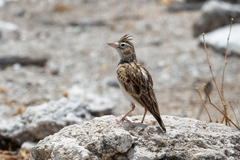
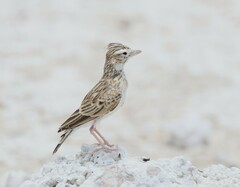
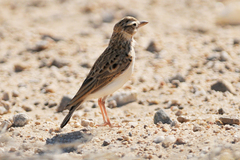
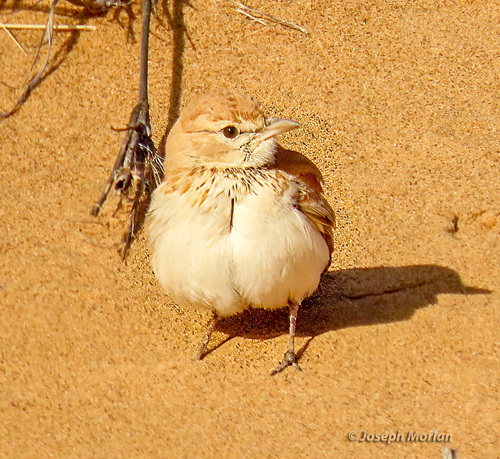
Stark's lark was originally classified in the genus Calandrella and was then moved from the genus Eremalauda to Spizocorys in 2009. This species is alternately named as Stark's short-toed lark. It is a pale medium-small lark with a pale, stout bill that appears slightly swollen. It exhibits a subtle streaky pattern on its sandy-brown upperparts and a distinct pale eyebrow. The underparts are whitish with faint streaking, and the lark often displays a raised, streaked crest.

Stark's Larks are highly mobile, exhibiting nomadic behavior. Following rainfall events, they may form flocks ranging from small groups to large ones, occasionally associating with other species such as sparrow-larks or buntings. These birds exhibit a preference for arid grasslands characterized by gravel substrates, avoiding sandy areas. To cope with high ambient temperatures... Wikipedia →

Global Distribution

Parks Where Found

# Park Country Daily sighting probability
1 Etosha National Park 🇳🇦 Namibia
~20%
2 Namib-Naukluft National Park 🇳🇦 Namibia
~10%
3 Kgalagadi Transfrontier Park 🇿🇦 South Africa
<5%

Before you go

What are the chances of seeing a Stark's Lark in Namib-Naukluft National Park?

With luck

About 10% of wildlife watchers report a Stark's Lark sighting in Namib-Naukluft National Park on a given day, based on 62 verified sightings from GBIF citizen-science data from 2019 to 2026. It is the 60th most-seen of the 108 birds we can rate there. Over three days the chance rises to about 20%, and over a week to about 40%, if each day is a fresh chance.

When is the best time to see a Stark's Lark in Namib-Naukluft National Park?

March and November

In those months about 20% of wildlife watchers report a Stark's Lark in Namib-Naukluft National Park on a given day, against under 5% in February, April, June–July, September–October and December, the lowest months.

What time of day is best to see a Stark's Lark?

Between 10 am and 1 pm

Across all the parks we cover, that three-hour window holds the most Stark's Lark sightings with a recorded time, and about 9 in 10 of them come between 6 am and 6 pm: it is a daytime animal.

Is Namib-Naukluft National Park the best place to see a Stark's Lark?

2nd of 3

Of the 3 parks where we can rate Stark's Lark sightings, Namib-Naukluft National Park ranks 2nd at about 10%. The best odds are in Etosha National Park (Namibia, about 20%).

Which relatives of the Stark's Lark live in Namib-Naukluft National Park?

Same family: Alaudidae

The closest relatives of the Stark's Lark that you can see in Namib-Naukluft National Park (family Alaudidae, Larks) are Dune Lark (about 40%), Grey-backed Sparrow-Lark (about 10%) and Gray's Lark (about 10%), with each one's daily chance of a sighting.

Where does the Stark's Lark sighting chance come from?

GBIF citizen-science records

It is estimated from how often the Stark's Lark is recorded against all the birds logged in Namib-Naukluft National Park (62 verified sightings from 2019 to 2026), calibrated against known sighting rates. Figures are rounded to the nearest 10% because citizen-science data supports honest approximations, not decimals, and months with records from fewer than five people show "—". How it works.

← Back to Namib-Naukluft National Park