Chestnut-Banded Plover

Chestnut-Banded Plover

Charadrius pallidus

LCLeast ConcernNTVUENCR
Daily sighting probability ~20% · Possible
at Ngorongoro Conservation Area

In 3 days ~50% in a week ~80%

320 Verified sightings at Ngorongoro Conservation Area From 2019 to 2026
658 In all 6 parks
April Best month

About the Chestnut-Banded Plover

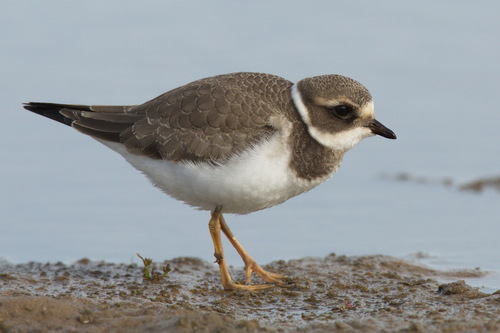
The chestnut-banded plover (Anarhynchus pallidus) is a species of bird in the family Charadriidae. This species has a large range, being distributed across Southern Africa. However, it occupies a rather small area. It grows about 15 cm tall and has proportionally long dark legs, black lores and eye-stripes leading to a black bill. The forehead, throat and belly are white, while a chestnut breast-band joins a band of same colour on the fore-crown. Back and crown are greyish brown.

Although this species' movements vary throughout its range and are therefore poorly understood it is thought to be a partial migrant. The number of chestnut-banded plovers varies from year to year at any given site. Especially in response to droughts at inland breeding sites will the population fluctuate, reflecting even on the size of the global population. Breeding mostly coincides with rains.

This bird can usually be found in pairs of small groups. Pairs defend territories particularly during the breeding season. During the non-breeding season, it forms very large communities. At one point, 375 birds were seen together in Namibia. It is known to...

Wikipedia →

Sounds

Call0:48

Namibia · 2016

© Peter Boesman · XC346692 · CC BY-NC-ND 4.0

Call0:04

South Africa · 2007

© Patrik Åberg · XC28681 · CC BY-NC-SA 3.0

Global Distribution

Parks Where Found

# Park Country Daily sighting probability
1 Ngorongoro Conservation Area 🇹🇿 Tanzania
~20%
2 Namib-Naukluft National Park 🇳🇦 Namibia
~10%
3 Serengeti National Park 🇹🇿 Tanzania
~10%
4 Etosha National Park 🇳🇦 Namibia
~10%
5 Addo Elephant National Park 🇿🇦 South Africa
~10%
6 iSimangaliso Wetland Park 🇿🇦 South Africa
~10%

Before you go

What are the chances of seeing a Chestnut-Banded Plover in Ngorongoro Conservation Area?

Possible

About 20% of wildlife watchers report a Chestnut-Banded Plover sighting in Ngorongoro Conservation Area on a given day, based on 320 verified sightings from GBIF citizen-science data from 2019 to 2026. It is the 77th most-seen of the 524 birds we can rate there. Over three days the chance rises to about 50%, and over a week to about 80%, if each day is a fresh chance.

When is the best time to see a Chestnut-Banded Plover in Ngorongoro Conservation Area?

February, April and November

In those months about 30% of wildlife watchers report a Chestnut-Banded Plover in Ngorongoro Conservation Area on a given day, against under 5% in October, the lowest month. Those are among Ngorongoro Conservation Area's wettest months, with about 140 mm of rain a month against almost none in July.

Is Ngorongoro Conservation Area the best place to see a Chestnut-Banded Plover?

Yes

Of the 6 parks where we can rate Chestnut-Banded Plover sightings, Ngorongoro Conservation Area has the highest daily chance: about 20%. Next come Namib-Naukluft National Park (Namibia, about 10%) and Serengeti National Park (Tanzania, about 10%).

Which relatives of the Chestnut-Banded Plover live in Ngorongoro Conservation Area?

Same genus: Charadrius

The closest relatives of the Chestnut-Banded Plover that you can see in Ngorongoro Conservation Area (genus Charadrius, Holarctic Ringed Plovers and Allies) are Kittlitz's Plover (about 40%), Three-Banded Plover (about 20%) and Common Ringed Plover (about 10%), with each one's daily chance of a sighting.

Where does the Chestnut-Banded Plover sighting chance come from?

GBIF citizen-science records

It is estimated from how often the Chestnut-Banded Plover is recorded against all the birds logged in Ngorongoro Conservation Area (320 verified sightings from 2019 to 2026), calibrated against known sighting rates. Figures are rounded to the nearest 10% because citizen-science data supports honest approximations, not decimals, and months with records from fewer than five people show "—". How it works.

← Back to Ngorongoro Conservation Area