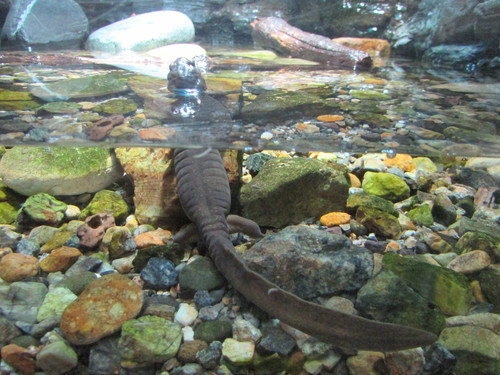
Japanese Fire Belly Newt

Japanese Fire Belly Newt

Cynops pyrrhogaster

Silhouette: Kai Caspar · PhyloPic

LCNTNear ThreatenedVUENCR Endemic
Daily sighting probability ~40% · Likely
at Nikko National Park

In 3 days ~80% in a week >90%

30 Verified sightings at Nikko National Park From 2019 to 2026
30 In 1 park
May Best month
🌅 Crepuscular When it's spotted

About the Japanese Fire Belly Newt

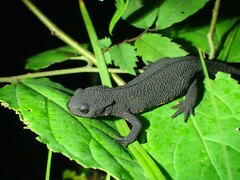
The Japanese fire-bellied newt or Japanese fire-bellied salamander (Cynops pyrrhogaster) is a species of newt endemic to Japan. The skin on its upper body is dark and its lower regions bright red, although coloration varies with age, genetics, and region. Adults are 8 to 15 cm (3.1 to 5.9 in) long. To deter predators, Japanese fire-bellied newts contain high levels of tetrodotoxin, a neurotoxin accumulated mainly from their diet.

The species is found on many Japanese islands, including Honshu, Shikoku, and Kyushu. Their habitats include both natural and artificial bodies of water, as well as forests and grasslands. They breed from spring to the beginning of summer, both sexes producing pheromones when ready to mate. Eggs are laid separately, hatching after about three weeks. They grow from larval to juvenile form in between five and six months. Juveniles eat soil-dwelling prey, and adults eat a wide variety of insects, tadpoles, and the eggs of their own species. They have several adaptations to avoid predators, although which they use depends on where they live. Several aspects of their biology have been studied, including their ability to regrow missing body parts.

The Japanese fire-bellied newt first diverged from its closest relative in the Middle Miocene, before splitting into four distinct varieties, each with a mostly separate range, although all four are formally recognized as composing a single species. Currently, their population is declining, and they face threats from disease and the pet trade. They can be successfully kept in captivity. Wikipedia →

Global Distribution

Parks Where Found

# Park Country Daily sighting probability
1 Nikko National Park 🇯🇵 Japan
~40%

More parks will be added in future updates.

Zoos & Centres Where Found

# Zoo / Centre Country
1 Chiba Zoological Park 🇯🇵 Japan In captivity
2 Zoo Opole 🇵🇱 Poland In captivity
3 動物の森 🇯🇵 Japan In captivity
4 L'Oceanogràfic 🇪🇸 Spain In captivity
5 Takeshima Aquarium 🇯🇵 Japan In captivity
6 Lake Biwa Museum 🇯🇵 Japan In captivity
7 Sunshine Aquarium 🇯🇵 Japan In captivity

Before you go

What are the chances of seeing a Japanese Fire Belly Newt in Nikko National Park?

Likely

About 40% of wildlife watchers report a Japanese Fire Belly Newt sighting in Nikko National Park on a given day, based on 30 verified sightings from GBIF citizen-science data from 2019 to 2026. Over three days the chance rises to about 80%, and over a week to over 90%, if each day is a fresh chance.

When is the best time to see a Japanese Fire Belly Newt in Nikko National Park?

May and August–September

In those months about 50% of wildlife watchers report a Japanese Fire Belly Newt in Nikko National Park on a given day, against about 10% in December to March, the lowest months.

What time of day is best to see a Japanese Fire Belly Newt?

Between 4 and 7 am

Across all the parks we cover, that three-hour window holds the most Japanese Fire Belly Newt sightings with a recorded time, and about half of them come between 6 am and 6 pm: it is most active around dawn and dusk.

Where else can you see a Japanese Fire Belly Newt?

Only Nikko National Park, in our data

Nikko National Park is the only park on Wallace's Line with enough records to rate Japanese Fire Belly Newt sightings: about 40% of wildlife watchers there report one on a given day.

Where does the Japanese Fire Belly Newt sighting chance come from?

GBIF citizen-science records

It is estimated from how often the Japanese Fire Belly Newt is recorded against all the amphibians logged in Nikko National Park (30 verified sightings from 2019 to 2026), calibrated against known sighting rates. Figures are rounded to the nearest 10% because citizen-science data supports honest approximations, not decimals, and months with records from fewer than five people show "—". How it works.

← Back to Nikko National Park