Tiger Keelback

Tiger Keelback

Rhabdophis tigrinus

Silhouette: V. Deepak · PhyloPic

LCLeast ConcernNTVUENCR
Daily sighting probability ~40% · Likely
at Nikko National Park

In 3 days ~80% in a week >90%

14 Verified sightings at Nikko National Park From 2019 to 2026
14 In 1 park
August Best month
🌅 Crepuscular When it's spotted

About the Tiger Keelback

Rhabdophis tigrinus, also known commonly as the tiger keelback, yamakagashi, or kkotbaem, is a species of venomous snake in the subfamily Natricinae of the family Colubridae. The species is native to East Asia and Southeast Asia. Many sources, though not ITIS, recognize one subspecies, Rhabdophis tigrinus formosanus of Taiwan.

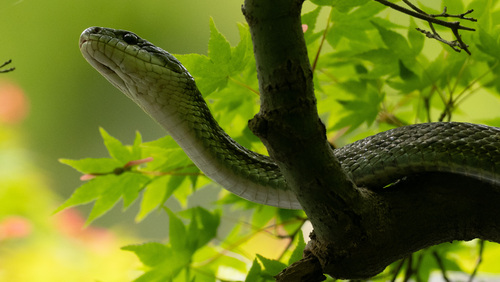
The dorsal color pattern of R. tigrinus is olive-drab green, with black and bright orange crossbars or spots from the neck down the first third of the body. The belly is whitish. The average total length (including tail) is usually 60–100 cm (24–39 in).

R. tigrinus is found in eastern Russia (Primorskiy and Khabarovsk territories), North and South Korea, China (widespread, except in the western third and the extreme south; Zhejiang, Fujian, Jiangxi, Hubei, Guizhou, Sichuan, Gansu, Shaanxi and Inner Mongolia), on the island of Taiwan, in Vietnam and in Japan (Yakushima, Tanegashima, Kyūshū, Shikoku, Honshu, Osaka and in the Ryukyu Islands). The type locality given is "Japan".

The diet of R. tigrinus consists mainly of small vertebrates, especially frogs and toads. It forages using both chemical (smell/tongue... Wikipedia →

Global Distribution

Parks Where Found

# Park Country Daily sighting probability
1 Nikko National Park 🇯🇵 Japan
~40%

More parks will be added in future updates.

Cities Where Found

# City Country Daily sighting probability
1 Beijing 🇨🇳 China
~10%
2 Seoul 🇰🇷 South Korea
~10%
3 Osaka 🇯🇵 Japan
~10%
4 Tokyo 🇯🇵 Japan
<5%

Before you go

What are the chances of seeing a Tiger Keelback in Nikko National Park?

Likely

About 40% of wildlife watchers report a Tiger Keelback sighting in Nikko National Park on a given day, based on 14 verified sightings from GBIF citizen-science data from 2019 to 2026. Over three days the chance rises to about 80%, and over a week to over 90%, if each day is a fresh chance.

When is the best time to see a Tiger Keelback in Nikko National Park?

June and August–September

In those months about 60% of wildlife watchers report a Tiger Keelback in Nikko National Park on a given day, against about 10% in February–March and October, the lowest months.

What time of day is best to see a Tiger Keelback?

Between 5 and 8 am

Across all the parks we cover, that three-hour window holds the most Tiger Keelback sightings with a recorded time, and about 6 in 10 of them come between 6 am and 6 pm: it is most active around dawn and dusk.

Where else can you see a Tiger Keelback?

Only Nikko National Park, in our data

Nikko National Park is the only park on Wallace's Line with enough records to rate Tiger Keelback sightings: about 40% of wildlife watchers there report one on a given day.

Which relatives of the Tiger Keelback live in Nikko National Park?

Same family: Colubridae

The closest relatives of the Tiger Keelback that you can see in Nikko National Park (family Colubridae, Colubrid Snakes) are Japanese Rat Snake (about 30%) and Burrowing Ratsnake (about 30%), with each one's daily chance of a sighting.

Where does the Tiger Keelback sighting chance come from?

GBIF citizen-science records

It is estimated from how often the Tiger Keelback is recorded against all the reptiles logged in Nikko National Park (14 verified sightings from 2019 to 2026), calibrated against known sighting rates. Figures are rounded to the nearest 10% because citizen-science data supports honest approximations, not decimals, and months with records from fewer than five people show "—". How it works.

← Back to Nikko National Park