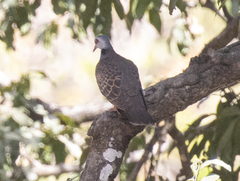
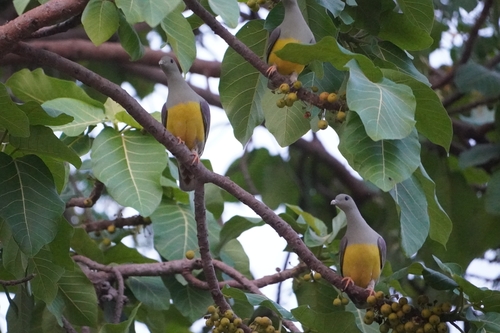
Adamawa Turtle Dove

Adamawa Turtle Dove

Streptopelia hypopyrrha

Silhouette: Andy Wilson · PhyloPic

LCLeast ConcernNTVUENCR
Daily sighting probability ~30% · Possible
at Niokolo-Koba National Park

In 3 days ~70% in a week ~90%

151 Verified sightings at Niokolo-Koba National Park From 2019 to 2026
151 In 1 park
December Best month
☀️ Diurnal When it's spotted

About the Adamawa Turtle Dove

The Adamawa turtle dove (Streptopelia hypopyrrha) is a species of bird in the pigeon and dove family Columbidae. It is also known as the pink-bellied turtle dove. The species is closely related to and has been considered the same species as the dusky turtle dove. The species has a disjunct distribution, being native to Cameroon, Nigeria and southwestern Chad and further west in Gambia, Senegal and Mali. It has also been reported defending a territory in Togo, suggesting a population may exist there too.

The Adamawa turtle dove measures 30 to 31 cm (12–12 in) in length and weighs 147–187 g (5.2–6.6 oz). It has a silver-grey face and a blue-grey head, a distinctive dark black patch on the shoulder, with a pink belly and breast and brown upperparts edged with grey-brown. Females and juveniles are paler than the males.

The Adamawa turtle dove inhabits a range of habitats, from sea level to 1,200 m (3,900 ft), particularly forest edge, wooded ravines, gallery forest, suburban gardens and farmland. It is uncertain if the species is migratory, or possibly nomadic, as periods when the species is present in unexpected locations may simply reflect poor ornithological knowledge of the area.

Little is known about its behaviour. It feeds on the ground on seeds, sometimes in flocks of up to 60 birds in the non-breeding season, and sometimes with other dove species. Breeding occurs at the end of the dry season. Males display to females through a display flight, with energetic flapping upwards followed by a slow glide down. Both parents build the flimsy nest, and the two eggs are white.

The conservation status of the Adamawa turtle dove was assessed by BirdLife International in 2012. It is considered to be a species of least concern. Wikipedia →

Sounds

Song1:25

Senegal · 2018

© Andrew Spencer · XC454606 · CC BY-NC-ND 4.0

Song0:13

Cameroon · 1998

© selvino · XC156458 · CC BY-NC-SA 3.0

Song1:03

Senegal · 2026

© Peter Boesman · XC1081413 · CC BY-NC-ND 4.0

Global Distribution

Parks Where Found

# Park Country Daily sighting probability
1 Niokolo-Koba National Park 🇸🇳 Senegal
~30%

More parks will be added in future updates.

Zoos & Centres Where Found

# Zoo / Centre Country
1 San Diego Zoo 🇺🇸 United States In captivity

Before you go

What are the chances of seeing an Adamawa Turtle Dove in Niokolo-Koba National Park?

Possible

About 30% of wildlife watchers report an Adamawa Turtle Dove sighting in Niokolo-Koba National Park on a given day, based on 151 verified sightings from GBIF citizen-science data from 2019 to 2026. It is the 60th most-seen of the 215 birds we can rate there. Over three days the chance rises to about 70%, and over a week to about 90%, if each day is a fresh chance.

When is the best time to see an Adamawa Turtle Dove in Niokolo-Koba National Park?

March and December–January

In those months about 40% of wildlife watchers report an Adamawa Turtle Dove in Niokolo-Koba National Park on a given day, against about 20% in August–September and November, the lowest months. Those are among Niokolo-Koba National Park's driest months, with almost no rain against 300 mm in August. May–July and October have too few records to rate.

What time of day is best to see an Adamawa Turtle Dove?

Between 8 and 11 am

Across all the parks we cover, that three-hour window holds the most Adamawa Turtle Dove sightings with a recorded time, and about 8 in 10 of them come between 6 am and 6 pm: it is a daytime animal.

Where else can you see an Adamawa Turtle Dove?

Only Niokolo-Koba National Park, in our data

Niokolo-Koba National Park is the only park on Wallace's Line with enough records to rate Adamawa Turtle Dove sightings: about 30% of wildlife watchers there report one on a given day.

Which relatives of the Adamawa Turtle Dove live in Niokolo-Koba National Park?

Same genus: Streptopelia

The closest relatives of the Adamawa Turtle Dove that you can see in Niokolo-Koba National Park (genus Streptopelia, Turtle-Doves and Collared-Doves) are Vinaceous Dove (about 70%), African Mourning Dove (about 50%) and Red-eyed Dove (about 40%), with each one's daily chance of a sighting.

Where does the Adamawa Turtle Dove sighting chance come from?

GBIF citizen-science records

It is estimated from how often the Adamawa Turtle Dove is recorded against all the birds logged in Niokolo-Koba National Park (151 verified sightings from 2019 to 2026), calibrated against known sighting rates. Figures are rounded to the nearest 10% because citizen-science data supports honest approximations, not decimals, and months with records from fewer than five people show "—". How it works.

← Back to Niokolo-Koba National Park