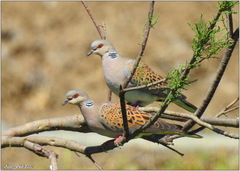

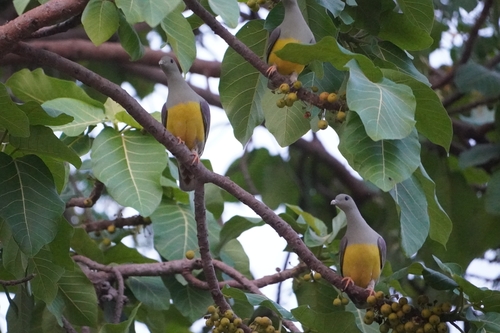
European Turtle Dove

European Turtle Dove

Streptopelia turtur

Silhouette: Andy Wilson · PhyloPic

LCNTVUVulnerableENCR
Daily sighting probability ~20% · Possible
at Niokolo-Koba National Park

In 3 days ~40% in a week ~70%

66 Verified sightings at Niokolo-Koba National Park From 2019 to 2026
1,572 In all 11 parks
April Best month
☀️ Diurnal When it's spotted

About the European Turtle Dove

The European turtle dove (Streptopelia turtur) is a threatened or vulnerable member of the bird family Columbidae, the doves and pigeons. It breeds over a wide area of the south western Palearctic including north Africa but migrates to northern sub-Saharan Africa in winter.

The European turtle dove was formally described by the Swedish naturalist Carl Linnaeus in 1758 in the tenth edition of his Systema Naturae. He placed it with all the other pigeons in the genus Columba and coined the binomial name Columba turtur. The specific epithet turtur is the Latin word for a turtle dove. Linnaeus gave the locality as "India". This was an error, and the type locality has been designated as England. The species is now placed in the genus Streptopelia that was introduced in 1855 by the French ornithologist Charles Lucien Bonaparte.

Four subspecies are recognised: Wikipedia →

Sounds

Song0:37

United Kingdom · 2026

© Ian Roberts · XC1105940 · CC BY-NC-SA 4.0

Aberrant0:20

Netherlands · 2026

© Joost van Bruggen · XC1105933 · CC BY-NC-ND 4.0

Call1:30

United Kingdom · 2022

© Frank Lambert · XC741438 · CC BY-NC-ND 4.0

Global Distribution

Parks Where Found

# Park Country Daily sighting probability
1 Fertő-Hanság National Park 🇭🇺 Hungary
~30%
2 Kiskunság National Park 🇭🇺 Hungary
~20%
3 Niokolo-Koba National Park 🇸🇳 Senegal
~20%
4 Hortobágy National Park 🇭🇺 Hungary
~10%
5 Camargue 🇫🇷 France
~10%
6 Monfragüe National Park 🇪🇸 Spain
~10%
7 Doñana National Park 🇪🇸 Spain
~10%
8 Sierra Nevada National Park 🇪🇸 Spain
<5%
9 Sierra de Guadarrama National Park 🇪🇸 Spain
<5%
10 Biebrza National Park 🇵🇱 Poland
<5%
11 Pyrénées National Park 🇫🇷 France
<5%

Cities Where Found

# City Country Daily sighting probability
1 Marrakesh 🇲🇦 Morocco
~20%
2 Tel Aviv 🇮🇱 Israel
~20%
3 Fez 🇲🇦 Morocco
~10%
4 Tunis 🇹🇳 Tunisia
~10%
5 Jerusalem 🇮🇱 Israel
~10%
6 Luxor 🇪🇬 Egypt
~10%
7 Naples 🇮🇹 Italy
<5%
8 Lisbon 🇵🇹 Portugal
<5%
9 Cairo 🇪🇬 Egypt
<5%
10 Ramallah 🇵🇸 Palestine
<5%

Zoos & Centres Where Found

# Zoo / Centre Country
1 Natura Artis Magistra 🇳🇱 Netherlands In captivity
2 Zoo Pilsen 🇨🇿 Czechia In captivity
3 Parc des oiseaux 🇫🇷 France In captivity
4 Slimbridge Wetland Centre 🇬🇧 United Kingdom In captivity
5 Berlin Zoological Garden 🇩🇪 Germany In captivity
6 Dierenpark Hoenderdaell 🇳🇱 Netherlands In captivity
7 Wrocław Zoological Garden 🇵🇱 Poland In captivity
8 Diergaarde Blijdorp 🇳🇱 Netherlands In captivity
9 Bristol Zoo Project 🇬🇧 United Kingdom In captivity
10 Hanover Zoo 🇩🇪 Germany In captivity
11 Birdworld 🇬🇧 United Kingdom In captivity
12 Tierpark Hexentanzplatz 🇩🇪 Germany In captivity
13 Santillana Zoo 🇪🇸 Spain In captivity
14 Birdland Park and Gardens 🇬🇧 United Kingdom In captivity
15 Storchenstation 🇨🇭 Switzerland In captivity
16 Africarium 🇵🇱 Poland In captivity
17 Oceanium 🇳🇱 Netherlands In captivity
18 Aquarium Berlin 🇩🇪 Germany In captivity
19 Cologne Zoo Aquarium 🇩🇪 Germany In captivity
20 Landgoed Hoenderdaell 🇳🇱 Netherlands In captivity
21 terrarium ogrodu zoologicznego we Wrocławiu 🇵🇱 Poland In captivity

Before you go

What are the chances of seeing a European Turtle Dove in Niokolo-Koba National Park?

Possible

About 20% of wildlife watchers report a European Turtle Dove sighting in Niokolo-Koba National Park on a given day, based on 66 verified sightings from GBIF citizen-science data from 2019 to 2026. It is the 101st most-seen of the 215 birds we can rate there. Over three days the chance rises to about 40%, and over a week to about 70%, if each day is a fresh chance.

When is the best time to see a European Turtle Dove in Niokolo-Koba National Park?

February and April

In those months about 30% of wildlife watchers report a European Turtle Dove in Niokolo-Koba National Park on a given day, against about 10% in January, August–September and November, the lowest months. Those are among Niokolo-Koba National Park's driest months, with almost no rain against 300 mm in August. May–July and October have too few records to rate.

What time of day is best to see a European Turtle Dove?

Between 8 and 11 am

Across all the parks we cover, that three-hour window holds the most European Turtle Dove sightings with a recorded time, and about 7 in 10 of them come between 6 am and 6 pm: it is a daytime animal.

Is Niokolo-Koba National Park the best place to see a European Turtle Dove?

3rd of 11

Of the 11 parks where we can rate European Turtle Dove sightings, Niokolo-Koba National Park ranks 3rd at about 20%. The best odds are in Fertő-Hanság National Park (Hungary, about 30%) and Kiskunság National Park (Hungary, about 20%).

Which relatives of the European Turtle Dove live in Niokolo-Koba National Park?

Same genus: Streptopelia

The closest relatives of the European Turtle Dove that you can see in Niokolo-Koba National Park (genus Streptopelia, Turtle-Doves and Collared-Doves) are Vinaceous Dove (about 70%), African Mourning Dove (about 50%) and Red-eyed Dove (about 40%), with each one's daily chance of a sighting.

Where does the European Turtle Dove sighting chance come from?

GBIF citizen-science records

It is estimated from how often the European Turtle Dove is recorded against all the birds logged in Niokolo-Koba National Park (66 verified sightings from 2019 to 2026), calibrated against known sighting rates. Figures are rounded to the nearest 10% because citizen-science data supports honest approximations, not decimals, and months with records from fewer than five people show "—". How it works.

← Back to Niokolo-Koba National Park