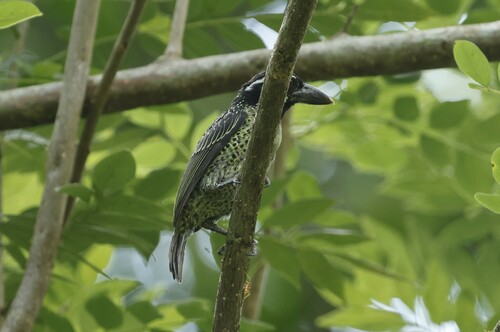
Bristle-nosed Barbet

Bristle-nosed Barbet

Gymnobucco peli

LCLeast ConcernNTVUENCR
Daily sighting probability ~20% · Possible
at Odzala-Kokoua National Park

In 3 days ~50% in a week ~80%

7 Verified sightings at Odzala-Kokoua National Park From 2019 to 2026
7 In 1 park
September Best month
☀️ Diurnal When it's spotted

About the Bristle-nosed Barbet

The bristle-nosed barbet (Gymnobucco peli) is a bird species in the family Lybiidae. It used to be placed in the family Bucconidae (puffbirds), which has been split up; alternatively, it may be included in a vastly expanded Ramphastidae (toucans).

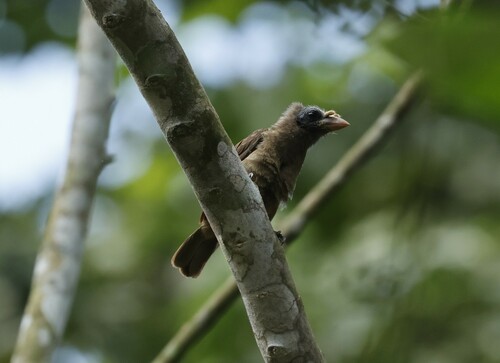
Its range covers areas near the Gulf of Guinea (on either side of the Dahomey Gap), from eastern Sierra Leone to far northwestern Angola. The Bristle-nosed barbet is a dark, stocky bird characterized by a prominent buff tuft of feathers on its forehead. It is typically found in small groups, frequenting dead trees in rainforests, secondary growth, and plantations, often alongside Naked-faced or Grey-throated Barbets. It closely resembles the Naked-faced Barbet but can be distinguished by the prominent tuft above its bill. Additionally, while similar to the Gray-throated Barbet, it is set apart by its mostly unfeathered head and pale bill.

Its vocalizations include nasal "squeaky toy" calls, a dry rattle, and a series of uniform hollow hoots. The Bristle-nosed Barbet remains poorly studied in terms of its lifestyle and behavior. It forages in the foliage of fruit-bearing trees, often hanging upside down from... Wikipedia →
Sounds

Call0:13

Gabon · 2022

© Étienne Leroy · XC762139 · CC BY-NC-SA 4.0

Recording0:09

Guinea · 2025

© Simon Cavaillès · XC1001295 · CC BY-NC-SA 4.0

Call0:47

Central African Republic · 2021

© Rod Cassidy · XC624075 · CC BY-NC-SA 4.0

Global Distribution

Parks Where Found

# Park Country Daily sighting probability
1 Odzala-Kokoua National Park 🇨🇬 Republic of the Congo
~20%

More parks will be added in future updates.

Before you go

What are the chances of seeing a Bristle-nosed Barbet in Odzala-Kokoua National Park?

Possible

About 20% of wildlife watchers report a Bristle-nosed Barbet sighting in Odzala-Kokoua National Park on a given day, based on 7 verified sightings from GBIF citizen-science data from 2019 to 2026. It is the 47th most-seen of the 72 birds we can rate there. Over three days the chance rises to about 50%, and over a week to about 80%, if each day is a fresh chance.

When is the best time to see a Bristle-nosed Barbet in Odzala-Kokoua National Park?

September

In that month about 40% of wildlife watchers report a Bristle-nosed Barbet in Odzala-Kokoua National Park on a given day, against under 5% in April, August and November–February, the lowest months. That is one of Odzala-Kokoua National Park's wettest months, with about 190 mm of rain against 50 mm in January.

What time of day is best to see a Bristle-nosed Barbet?

Between 9 am and noon

Across all the parks we cover, that three-hour window holds the most Bristle-nosed Barbet sightings with a recorded time, and about 8 in 10 of them come between 6 am and 6 pm: it is a daytime animal.

Where else can you see a Bristle-nosed Barbet?

Only Odzala-Kokoua National Park, in our data

Odzala-Kokoua National Park is the only park on Wallace's Line with enough records to rate Bristle-nosed Barbet sightings: about 20% of wildlife watchers there report one on a given day.

Which relatives of the Bristle-nosed Barbet live in Odzala-Kokoua National Park?

Same family: Lybiidae

The closest relatives of the Bristle-nosed Barbet that you can see in Odzala-Kokoua National Park (family Lybiidae, African Barbets) are Red-rumped Tinkerbird (about 30%), Yellow-throated Tinkerbird (about 30%) and Yellow-rumped Tinkerbird (about 30%), with each one's daily chance of a sighting.

Where does the Bristle-nosed Barbet sighting chance come from?

GBIF citizen-science records

It is estimated from how often the Bristle-nosed Barbet is recorded against all the birds logged in Odzala-Kokoua National Park (7 verified sightings from 2019 to 2026), calibrated against known sighting rates. Figures are rounded to the nearest 10% because citizen-science data supports honest approximations, not decimals, and months with records from fewer than five people show "—". How it works.

← Back to Odzala-Kokoua National Park