Marsh Mongoose

Marsh Mongoose

Atilax paludinosus

Silhouette: Margot Michaud · PhyloPic

LCLeast ConcernNTVUENCR
Daily sighting probability ~20% · Possible
at Odzala-Kokoua National Park

In 3 days ~50% in a week ~80%

8 Verified sightings at Odzala-Kokoua National Park From 2019 to 2026
51 In all 3 parks
August Best month
☀️ Diurnal When it's spotted

About the Marsh Mongoose

The marsh mongoose (Atilax paludinosus), also called water mongoose, is a medium-sized mongoose species native to sub-Saharan Africa that inhabits freshwater wetlands. It has been listed as a Least-concern species on the IUCN Red List since 2008.

The generic name Atilax was introduced in 1826 by Frédéric Cuvier. In 1829, Georges Cuvier referred to a mongoose in the marshes of the Cape Province using the scientific name Herpestes paludinosus. It is the only extant member of the genus Atilax, although an extinct ancestral species from the Early Pleistocene known as Atilax mesotes was also a member of the genus.

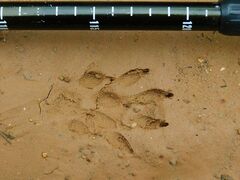
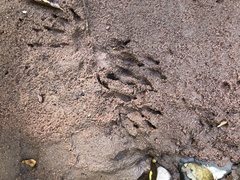
The marsh mongoose's fur is dark reddish brown to black with white and fawn coloured guard hairs. The hair behind the neck and in front of the back is short, but longer on the hind legs and on the tail. Its muzzle is short with a fawn coloured mouth, short whiskers and a naked rhinarium. It has 3.1.3.23.1.3.2 × 2 = 36 teeth. Its short ears are round. It has two nipples. Its feet have five flexible digits each with curved claws, but without any webbing. The soles of its feet are naked.

Females measure 48.72 cm (19.18 in) in head-to-body length... Wikipedia →

Global Distribution

Parks Where Found

# Park Country Daily sighting probability
1 Odzala-Kokoua National Park 🇨🇬 Republic of the Congo
~20%
2 Table Mountain National Park 🇿🇦 South Africa
~10%
3 Garden Route National Park 🇿🇦 South Africa
<5%

Cities Where Found

# City Country Daily sighting probability
1 Durban 🇿🇦 South Africa
~10%
2 Johannesburg 🇿🇦 South Africa
~10%
3 Cape Town 🇿🇦 South Africa
~10%

Zoos & Centres Where Found

# Zoo / Centre Country
1 Zoo Pilsen 🇨🇿 Czechia In captivity

Before you go

What are the chances of seeing a Marsh Mongoose in Odzala-Kokoua National Park?

Possible

About 20% of wildlife watchers report a Marsh Mongoose sighting in Odzala-Kokoua National Park on a given day, based on 8 verified sightings from GBIF citizen-science data from 2019 to 2026. It is the 21st most-seen of the 32 mammals we can rate there. Over three days the chance rises to about 50%, and over a week to about 80%, if each day is a fresh chance.

When is the best time to see a Marsh Mongoose in Odzala-Kokoua National Park?

August

In that month about 50% of wildlife watchers report a Marsh Mongoose in Odzala-Kokoua National Park on a given day, against under 5% in March–July and December–January, the lowest months.

What time of day is best to see a Marsh Mongoose?

Between 7 and 10 am

Across all the parks we cover, that three-hour window holds the most Marsh Mongoose sightings with a recorded time, and about 8 in 10 of them come between 6 am and 6 pm: it is a daytime animal.

Is Odzala-Kokoua National Park the best place to see a Marsh Mongoose?

Yes

Of the 3 parks where we can rate Marsh Mongoose sightings, Odzala-Kokoua National Park has the highest daily chance: about 20%. Next come Table Mountain National Park (South Africa, about 10%) and Garden Route National Park (South Africa, under 5%).

Where does the Marsh Mongoose sighting chance come from?

GBIF citizen-science records

It is estimated from how often the Marsh Mongoose is recorded against all the mammals logged in Odzala-Kokoua National Park (8 verified sightings from 2019 to 2026), calibrated against known sighting rates. Figures are rounded to the nearest 10% because citizen-science data supports honest approximations, not decimals, and months with records from fewer than five people show "—". How it works.

← Back to Odzala-Kokoua National Park