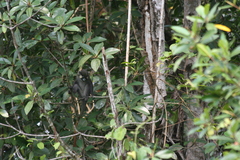
Moustached Monkey

Moustached Monkey

Cercopithecus cephus

LCLeast ConcernNTVUENCR
Daily sighting probability ~30% · Possible
at Odzala-Kokoua National Park

In 3 days ~70% in a week ~90%

14 Verified sightings at Odzala-Kokoua National Park From 2019 to 2026
14 In 1 park
November Best month
☀️ Diurnal When it's spotted

About the Moustached Monkey

The moustached guenon or moustached monkey (Cercopithecus cephus) is a species of primate in the family Cercopithecidae. It is found in Angola, Cameroon, Central African Republic, Republic of the Congo, Democratic Republic of the Congo, Equatorial Guinea, and Gabon.

This monkey is an arboreal, omnivorous, and medium-sized mammal. According to the IUCN, the population of the moustached monkeys is considered to be large. They are widely used in biological labs. The moustached guenon belongs to the genus Cercopithecus, a genus of Old World monkeys, and in the C. cephus group. It is named by its unique moustached face in the monkeys, which has three recognized subspecies: (1) Red-tailed moustached monkey (C. cephus cephus); (2) Gray-tailed Moustached Monkey (C. cephus cephodes); (3) White-nosed Moustached Monkey (C. cephus ngottoensis). However, the C. cephus group also includes many other long-tailed monkey that has other unique morphological patterns except the moustache, for example, the regular red-tailed monkeys (Cercopithecus scanius), the red-bellied monkey (C. e. erythrogaster) and the white-throated monkey (Cercopithecus erythrogaster). The diversity of the moustached... Wikipedia →

Global Distribution

Parks Where Found

# Park Country Daily sighting probability
1 Odzala-Kokoua National Park 🇨🇬 Republic of the Congo
~30%

More parks will be added in future updates.

Zoos & Centres Where Found

# Zoo / Centre Country
1 ZooParc de Beauval 🇫🇷 France In captivity
2 Hellabrunn Zoo 🇩🇪 Germany In captivity
3 ZOOM Erlebniswelt 🇩🇪 Germany In captivity
4 Zoo Schlichtweg 11 in München 🇩🇪 Germany In captivity
5 Zoo Siebenbrunner Straße 6 in München 🇩🇪 Germany In captivity

Before you go

What are the chances of seeing a Moustached Monkey in Odzala-Kokoua National Park?

Possible

About 30% of wildlife watchers report a Moustached Monkey sighting in Odzala-Kokoua National Park on a given day, based on 14 verified sightings from GBIF citizen-science data from 2019 to 2026. It is the 11th most-seen of the 32 mammals we can rate there. Over three days the chance rises to about 70%, and over a week to about 90%, if each day is a fresh chance.

When is the best time to see a Moustached Monkey in Odzala-Kokoua National Park?

November

In that month about 60% of wildlife watchers report a Moustached Monkey in Odzala-Kokoua National Park on a given day, against under 5% in February–April and December, the lowest months. That is one of Odzala-Kokoua National Park's wettest months, with about 190 mm of rain against 50 mm in January.

What time of day is best to see a Moustached Monkey?

Between 6 and 9 am

Across all the parks we cover, that three-hour window holds the most Moustached Monkey sightings with a recorded time, and about 9 in 10 of them come between 6 am and 6 pm: it is a daytime animal.

Where else can you see a Moustached Monkey?

Only Odzala-Kokoua National Park, in our data

Odzala-Kokoua National Park is the only park on Wallace's Line with enough records to rate Moustached Monkey sightings: about 30% of wildlife watchers there report one on a given day.

Which relatives of the Moustached Monkey live in Odzala-Kokoua National Park?

Same genus: Cercopithecus

The closest relatives of the Moustached Monkey that you can see in Odzala-Kokoua National Park (genus Cercopithecus, Guenons) are Putty-nosed Monkey (about 40%) and Crowned Monkey (about 20%), with each one's daily chance of a sighting.

Where does the Moustached Monkey sighting chance come from?

GBIF citizen-science records

It is estimated from how often the Moustached Monkey is recorded against all the mammals logged in Odzala-Kokoua National Park (14 verified sightings from 2019 to 2026), calibrated against known sighting rates. Figures are rounded to the nearest 10% because citizen-science data supports honest approximations, not decimals, and months with records from fewer than five people show "—". How it works.

← Back to Odzala-Kokoua National Park