Pyrenean Rock Lizard

Pyrenean Rock Lizard

Iberolacerta bonnali

Silhouette: Gustav Mützel · PhyloPic

LCNTNear ThreatenedVUENCR
Daily sighting probability ~10% · With luck
at Ordesa y Monte Perdido National Park

In 3 days ~30% in a week ~60%

13 Verified sightings at Ordesa y Monte Perdido National Park From 2019 to 2026
114 In all 3 parks
August Best month
☀️ Diurnal When it's spotted

About the Pyrenean Rock Lizard

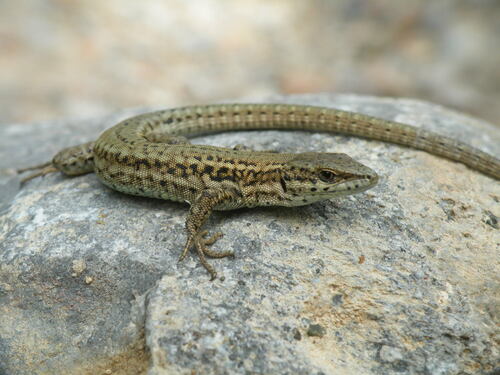
The Pyrenean rock lizard (Iberolacerta bonnali) is a species of lizard in the family Lacertidae. The species is endemic to the Pyrenees, where it occurs at high altitudes and is only active in summer. The specific name, bonnali, is in honor of the Count of Bonnal who collected amphibians and reptiles while living at Montgaillard, Hautes-Pyrénées.

The Aran rock lizard was initially included here as a subspecies, Iberolacerta bonnali aranica, but is now considered a distinct species, Iberolacerta aranica. The Pyrenean rock lizard grows to a snout-to-vent length (SVL) of 6 cm (2.4 in), with a tail about twice SVL. Its dorsal colour is greyish-brown, sometimes finely flecked with dark markings but without significant striping. The flanks are dark, sometimes with slight pale flecking. The underparts are white, greyish or greenish.

The Pyrenean rock lizard is found in France and Spain in the Pyrenees Mountains at altitudes of between 1,700 and 3,000 metres (5,600 and 9,800 ft). Its natural habitats are rocky crags and screes in limestone, slate and schist areas. It is frequently found on rocks close to alpine... Wikipedia →

Global Distribution

Parks Where Found

# Park Country Daily sighting probability
1 Aigüestortes National Park 🇪🇸 Spain
~20%
2 Pyrénées National Park 🇫🇷 France
~20%
3 Ordesa y Monte Perdido National Park 🇪🇸 Spain
~10%

Before you go

What are the chances of seeing a Pyrenean Rock Lizard in Ordesa y Monte Perdido National Park?

With luck

About 10% of wildlife watchers report a Pyrenean Rock Lizard sighting in Ordesa y Monte Perdido National Park on a given day, based on 13 verified sightings from GBIF citizen-science data from 2019 to 2026. It is the 5th most-seen of the 5 reptiles we can rate there. Over three days the chance rises to about 30%, and over a week to about 60%, if each day is a fresh chance.

When is the best time to see a Pyrenean Rock Lizard in Ordesa y Monte Perdido National Park?

August and September

In those months about 20% of wildlife watchers report a Pyrenean Rock Lizard in Ordesa y Monte Perdido National Park on a given day, against under 5% in October to June, the lowest months.

What time of day is best to see a Pyrenean Rock Lizard?

Between 11 am and 2 pm

Across all the parks we cover, that three-hour window holds the most Pyrenean Rock Lizard sightings with a recorded time, and about 9 in 10 of them come between 6 am and 6 pm: it is a daytime animal.

Is Ordesa y Monte Perdido National Park the best place to see a Pyrenean Rock Lizard?

3rd of 3

Of the 3 parks where we can rate Pyrenean Rock Lizard sightings, Ordesa y Monte Perdido National Park ranks 3rd at about 10%. The best odds are in Aigüestortes National Park (Spain, about 20%) and Pyrénées National Park (France, about 20%).

Which relatives of the Pyrenean Rock Lizard live in Ordesa y Monte Perdido National Park?

Same family: Lacertidae

The closest relatives of the Pyrenean Rock Lizard that you can see in Ordesa y Monte Perdido National Park (family Lacertidae, Wall Lizards) are Common Wall Lizard (about 80%) and Catalonian Wall Lizard (about 30%), with each one's daily chance of a sighting.

Where does the Pyrenean Rock Lizard sighting chance come from?

GBIF citizen-science records

It is estimated from how often the Pyrenean Rock Lizard is recorded against all the reptiles logged in Ordesa y Monte Perdido National Park (13 verified sightings from 2019 to 2026), calibrated against known sighting rates. Figures are rounded to the nearest 10% because citizen-science data supports honest approximations, not decimals, and months with records from fewer than five people show "—". How it works.

← Back to Ordesa y Monte Perdido National Park