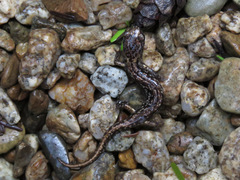
Wandering Salamander

Wandering Salamander

Aneides vagrans

Silhouette: Benjamin Monod-Broca · PhyloPic

LCLeast ConcernNTVUENCR
Daily sighting probability ~20% · Possible
at Pacific Rim National Park Reserve

In 3 days ~50% in a week ~80%

37 Verified sightings at Pacific Rim National Park Reserve From 2019 to 2026
131 In all 3 parks
April Best month
☀️🌙 Day & Night When it's spotted

About the Wandering Salamander

The wandering salamander (Aneides vagrans) is species of climbing salamander in the family Plethodontidae. It has a disjunct distribution, with one population in northern California and another on Vancouver Island. It is unclear whether this distribution is natural or the result of unintentional human introductions. While it can be found terrestrially, the species is known for its habitation of the forest canopy, particularly in the crowns of coast redwood trees. When disturbed, individuals of this species may leap from trees, gliding and controlling their descent in the air with various physical adaptations.

The wandering salamander is a long, slender salamander that grows to a snout-vent length of approximately 80 millimetres (3.1 in) and a total length of 130 millimetres (5.1 in). Its base color ranges from brown to light grey, with lighter bronze-grey mottling distributed across its dorsal surface. Juveniles also have a coppery-bronze stripe down the spine. The species has between 14 and 16 costal grooves, though 15 is most common. The head is broader and more triangular in males than in females. Like other plethodontid salamanders, they possess a pair of naso... Wikipedia →

Global Distribution

Parks Where Found

# Park Country Daily sighting probability
1 Redwood National Park 🇺🇸 United States
~30%
2 Pacific Rim National Park Reserve 🇨🇦 Canada
~20%
3 Great Bear Rainforest 🇨🇦 Canada
~10%

Before you go

What are the chances of seeing a Wandering Salamander in Pacific Rim National Park Reserve?

Possible

About 20% of wildlife watchers report a Wandering Salamander sighting in Pacific Rim National Park Reserve on a given day, based on 37 verified sightings from GBIF citizen-science data from 2019 to 2026. It is the 6th most-seen of the 7 amphibians we can rate there. Over three days the chance rises to about 50%, and over a week to about 80%, if each day is a fresh chance.

When is the best time to see a Wandering Salamander in Pacific Rim National Park Reserve?

April, August and November–December

In those months about 30% of wildlife watchers report a Wandering Salamander in Pacific Rim National Park Reserve on a given day, against under 5% in January and February, the lowest months.

What time of day is best to see a Wandering Salamander?

Between noon and 3 pm

Across all the parks we cover, that three-hour window holds the most Wandering Salamander sightings with a recorded time, and about 6 in 10 of them come between 6 am and 6 pm: it is seen both by day and at night.

Is Pacific Rim National Park Reserve the best place to see a Wandering Salamander?

2nd of 3

Of the 3 parks where we can rate Wandering Salamander sightings, Pacific Rim National Park Reserve ranks 2nd at about 20%. The best odds are in Redwood National Park (United States, about 30%).

Where does the Wandering Salamander sighting chance come from?

GBIF citizen-science records

It is estimated from how often the Wandering Salamander is recorded against all the amphibians logged in Pacific Rim National Park Reserve (37 verified sightings from 2019 to 2026), calibrated against known sighting rates. Figures are rounded to the nearest 10% because citizen-science data supports honest approximations, not decimals, and months with records from fewer than five people show "—". How it works.

← Back to Pacific Rim National Park Reserve