Tamaulipan Milksnake

Tamaulipan Milksnake

Lampropeltis annulata

Silhouette: Andy Wilson · PhyloPic

LCLeast ConcernNTVUENCR
Daily sighting probability ~10% · With luck
at Padre Island National Seashore

In 3 days ~20% in a week ~50%

6 Verified sightings at Padre Island National Seashore From 2019 to 2026
6 In 1 park
July Best month
☀️ Diurnal When it's spotted

About the Tamaulipan Milksnake

Lampropeltis annulata, commonly known as the Mexican or Tamaulipan milksnake, is a non-venomous species of milksnake (family Colubridae). It is native to northwestern Mexico and some adjacent Mexico–United States border regions.

This milksnake species is native to the dry, semi-arid regions of northeastern and north-central Mexico, predominantly the states of Coahuila, Tamaulipas and Nuevo León, and may additionally be found as far south as Guanajuato, Hidalgo, San Luis Potosí and Querétaro, and as far east as the coast of Veracruz. It may also be found as far north as southwestern Texas, United States, where it has been observed near cities as far north as Kerrville, Ozona, San Angelo and San Antonio, among others.

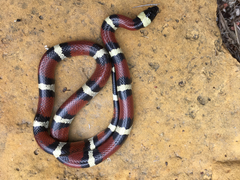
The Mexican milksnake has distinct red, black and cream or yellow-colored banding, wrapping around the body. This coloration is likely an evolutionary survival tactic to ward off potential predators by mimicking the venomous coral snake (Elapidae), which shares much of the same habitat, leading to the species sometimes being called a coral snake-"mimic." Localities indicate "whiter", brighter creams to the west, "dirtier... Wikipedia →

Global Distribution

Parks Where Found

# Park Country Daily sighting probability
1 Padre Island National Seashore 🇺🇸 United States
~10%

More parks will be added in future updates.

Zoos & Centres Where Found

# Zoo / Centre Country
1 San Diego Zoo 🇺🇸 United States In captivity
2 Gladys Porter Zoo 🇺🇸 United States In captivity
3 Snake Farm of Queen Saovabha Memorial Institute 🇹🇭 Thailand In captivity
4 Children's Aquarium at Fair Park 🇺🇸 United States In captivity

Before you go

What are the chances of seeing a Tamaulipan Milksnake in Padre Island National Seashore?

With luck

About 10% of wildlife watchers report a Tamaulipan Milksnake sighting in Padre Island National Seashore on a given day, based on 6 verified sightings from GBIF citizen-science data from 2019 to 2026. It is the 14th most-seen of the 15 reptiles we can rate there. Over three days the chance rises to about 20%, and over a week to about 50%, if each day is a fresh chance.

When is the best time to see a Tamaulipan Milksnake in Padre Island National Seashore?

July and November

In those months about 20% of wildlife watchers report a Tamaulipan Milksnake in Padre Island National Seashore on a given day, against under 5% in May–June, August–September and December–February, the lowest months.

What time of day is best to see a Tamaulipan Milksnake?

Between 10 am and 1 pm

Across all the parks we cover, that three-hour window holds the most Tamaulipan Milksnake sightings with a recorded time, and about 8 in 10 of them come between 6 am and 6 pm: it is a daytime animal.

Where else can you see a Tamaulipan Milksnake?

Only Padre Island National Seashore, in our data

Padre Island National Seashore is the only park on Wallace's Line with enough records to rate Tamaulipan Milksnake sightings: about 10% of wildlife watchers there report one on a given day.

Which relatives of the Tamaulipan Milksnake live in Padre Island National Seashore?

Same family: Colubridae

The closest relatives of the Tamaulipan Milksnake that you can see in Padre Island National Seashore (family Colubridae, Colubrid Snakes) are Western Ribbon Snake (about 40%), Coachwhip (about 30%) and Checkered Garter Snake (about 30%), with each one's daily chance of a sighting.

Where does the Tamaulipan Milksnake sighting chance come from?

GBIF citizen-science records

It is estimated from how often the Tamaulipan Milksnake is recorded against all the reptiles logged in Padre Island National Seashore (6 verified sightings from 2019 to 2026), calibrated against known sighting rates. Figures are rounded to the nearest 10% because citizen-science data supports honest approximations, not decimals, and months with records from fewer than five people show "—". How it works.

← Back to Padre Island National Seashore