Humboldt's Hog-nosed Skunk

Humboldt's Hog-nosed Skunk

Conepatus chinga

Silhouette: José Infante · PhyloPic

LCLeast ConcernNTVUENCR
Daily sighting probability ~30% · Possible
at Península Valdés

In 3 days ~70% in a week ~90%

13 Verified sightings at Península Valdés From 2019 to 2026
13 In 1 park
June Best month
☀️🌙 Day & Night When it's spotted

About the Humboldt's Hog-nosed Skunk

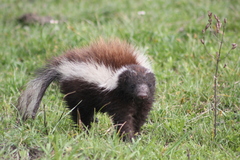
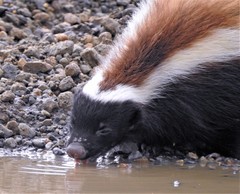
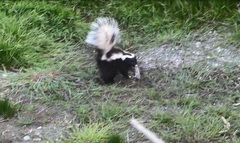
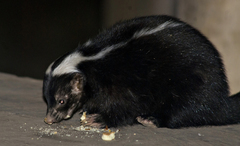
Molina's hog-nosed skunk, also called the Andes skunk (Conepatus chinga), is a skunk species from South America. It is found in Argentina, Bolivia, Brazil, Chile, Peru, Paraguay, and Uruguay, at elevations up to 5000 m. The Molina's hog-nosed skunk's native range is throughout mid to southern South America, Chile, Peru, northern Argentina, Bolivia, Paraguay, Uruguay, and southern Brazil. The mammal is therefore associated with temperate regions and open areas, mainly described as the Pampas biome and preferring to live in open vegetation, shrub forest and rocky sloped areas.

Typically they will live alone in an average home range size of about 1.66 individuals/km2 with some overlapping and about six skunks per 3.5 km2. Although living in mostly solitary areas, the skunks will come together temporarily for mating purposes.

Foraging mainly at night, the skunk is omnivorous, eating birds, small mammals, eggs, insects, leaves, and fruit. The tooth morphology in the Molina's hog-nosed skunk, is different from most mammals in that their teeth are adapted to their omnivorous diet with grinding being the main function of the carnassial... Wikipedia →

Global Distribution

Parks Where Found

# Park Country Daily sighting probability
1 Península Valdés 🇦🇷 Argentina
~30%

More parks will be added in future updates.

Zoos & Centres Where Found

# Zoo / Centre Country
1 Parc animalier de Sainte-Croix 🇫🇷 France In captivity

Before you go

What are the chances of seeing a Humboldt's Hog-nosed Skunk in Península Valdés?

Possible

About 30% of wildlife watchers report a Humboldt's Hog-nosed Skunk sighting in Península Valdés on a given day, based on 13 verified sightings from GBIF citizen-science data from 2019 to 2026. It is the 11th most-seen of the 12 mammals we can rate there. Over three days the chance rises to about 70%, and over a week to about 90%, if each day is a fresh chance.

When is the best time to see a Humboldt's Hog-nosed Skunk in Península Valdés?

June

In that month about 60% of wildlife watchers report a Humboldt's Hog-nosed Skunk in Península Valdés on a given day, against under 5% in August to October, the lowest months.

What time of day is best to see a Humboldt's Hog-nosed Skunk?

Between 6 and 9 pm

Across all the parks we cover, that three-hour window holds the most Humboldt's Hog-nosed Skunk sightings with a recorded time, and about 6 in 10 of them come between 6 am and 6 pm: it is seen both by day and at night.

Where else can you see a Humboldt's Hog-nosed Skunk?

Only Península Valdés, in our data

Península Valdés is the only park on Wallace's Line with enough records to rate Humboldt's Hog-nosed Skunk sightings: about 30% of wildlife watchers there report one on a given day.

Which relatives of the Humboldt's Hog-nosed Skunk live in Península Valdés?

Same order: Carnivora

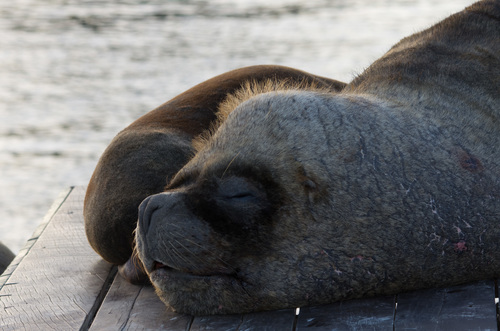
The closest relatives of the Humboldt's Hog-nosed Skunk that you can see in Península Valdés (order Carnivora, Carnivorans) are Southern Elephant Seal (about 90%), Southern Sea Lion (about 80%) and Pampas Fox (about 40%), with each one's daily chance of a sighting.

Where does the Humboldt's Hog-nosed Skunk sighting chance come from?

GBIF citizen-science records

It is estimated from how often the Humboldt's Hog-nosed Skunk is recorded against all the mammals logged in Península Valdés (13 verified sightings from 2019 to 2026), calibrated against known sighting rates. Figures are rounded to the nearest 10% because citizen-science data supports honest approximations, not decimals, and months with records from fewer than five people show "—". How it works.

← Back to Península Valdés