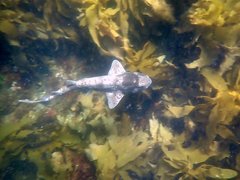
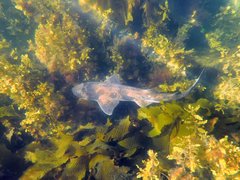
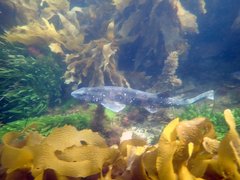
Australian Swellshark

Australian Swellshark

Cephaloscyllium laticeps

Daily sighting probability ~40% · Likely
at Phillip Island Nature Park

In 3 days ~80% in a week >90%

5 Verified sightings at Phillip Island Nature Park From 2019 to 2026
5 In 1 park
March Best month
☀️ Diurnal When it's spotted

About the Australian Swellshark

The Australian swellshark (Cephaloscyllium laticeps) or draughtboard shark, is a species of catshark, and part of the family Scyliorhinidae, endemic to southern Australia. This bottom-dwelling species can be found on the continental shelf down to a depth of 220 m (720 ft). Usually measuring 1 m (3 ft 3 in) long, it is a stout-bodied, broad-headed shark with a short tail and a first dorsal fin much larger than the second. It can be identified by its variegated dorsal coloration of brown or grey patches and numerous spots.

Australian swellsharks are sedentary and mainly nocturnal, with most individuals remaining within the same local area throughout the year. It feeds on small crustaceans, cephalopods, and fish. When threatened, it responds by rapidly taking in water or air to inflate its body, hence the name "swellshark". This shark is oviparous and females lay pairs of distinctively ridged egg capsules at 20- to 30-day intervals. The eggs hatch after 11–12 months. Harmless and of little commercial interest, many Australian swellsharks are caught incidentally in gillnets and bottom trawls but usually survive to be released because of their extreme hardiness. As a result, the International Union for Conservation of Nature (IUCN) has assessed this species as of Least Concern.

Wikipedia →

Global Distribution

Parks Where Found

# Park Country Daily sighting probability
1 Phillip Island Nature Park 🇦🇺 Australia
~40%

More parks will be added in future updates.

Before you go

What are the chances of seeing an Australian Swellshark in Phillip Island Nature Park?

Likely

About 40% of wildlife watchers report an Australian Swellshark sighting in Phillip Island Nature Park on a given day, based on 5 verified sightings from GBIF citizen-science data from 2019 to 2026. Over three days the chance rises to about 80%, and over a week to over 90%, if each day is a fresh chance.

When is the best time to see an Australian Swellshark in Phillip Island Nature Park?

March

In that month about 70% of wildlife watchers report an Australian Swellshark in Phillip Island Nature Park on a given day, against about 10% in December to February, the lowest months. June to September have too few records to rate.

What time of day is best to see an Australian Swellshark?

Between 8 and 11 am

Across all the parks we cover, that three-hour window holds the most Australian Swellshark sightings with a recorded time, and nearly all of them come between 6 am and 6 pm: it is a daytime animal.

Where else can you see an Australian Swellshark?

Only Phillip Island Nature Park, in our data

Phillip Island Nature Park is the only park on Wallace's Line with enough records to rate Australian Swellshark sightings: about 40% of wildlife watchers there report one on a given day.

Where does the Australian Swellshark sighting chance come from?

GBIF citizen-science records

It is estimated from how often the Australian Swellshark is recorded against all the sharks and rays logged in Phillip Island Nature Park (5 verified sightings from 2019 to 2026), calibrated against known sighting rates. Figures are rounded to the nearest 10% because citizen-science data supports honest approximations, not decimals, and months with records from fewer than five people show "—". How it works.

← Back to Phillip Island Nature Park