Eastern Barred Bandicoot

Eastern Barred Bandicoot

Perameles gunnii

LCNTVUVulnerableENCR Endemic
Daily sighting probability ~40% · Likely
at Phillip Island Nature Park

In 3 days ~80% in a week >90%

78 Verified sightings at Phillip Island Nature Park From 2019 to 2026
78 In 1 park
June Best month
🌙 Nocturnal When it's spotted

About the Eastern Barred Bandicoot

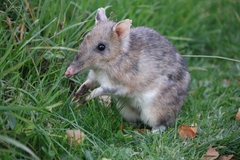
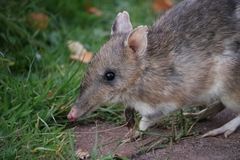
The eastern barred bandicoot (Perameles gunnii) is a nocturnal, rabbit-sized marsupial endemic to southeastern Australia, being native to the island of Tasmania and mainland Victoria. It is one of the four surviving bandicoot species in the genus Perameles. It is distinguishable from its partially-sympatric congener—the long-nosed bandicoot – via three or four dark horizontal bars found on its rump. In Tasmania, it is relatively abundant. The mainland population in Victoria is struggling and is subject to ongoing conservation endeavors.

The eastern barred bandicoot weighs less than 2 kg (4.4 lb) and has a short tail and three to four whitish bars across the rump. The eastern barred bandicoot has two separated populations, one on the mainland of Australia and one on the island of Tasmania. The Tasmanian form is somewhat larger than the mainland form as the average adult mass is 750 g (26 oz) in Victoria and 1,000 g (35 oz) in Tasmania. It lives for just two to three years and is not gregarious. Males occupy large home ranges compared to females and only consort with females for mating.

This species is nocturnal. It emerges from its nest at dusk to forage for a variety...

Wikipedia →

Global Distribution

Parks Where Found

# Park Country Daily sighting probability
1 Phillip Island Nature Park 🇦🇺 Australia
~40%

More parks will be added in future updates.

Cities Where Found

# City Country Daily sighting probability
1 Hobart 🇦🇺 Australia
~40%

Zoos & Centres Where Found

# Zoo / Centre Country
1 East Coast Natureworld 🇦🇺 Australia In captivity

Before you go

What are the chances of seeing an Eastern Barred Bandicoot in Phillip Island Nature Park?

Likely

About 40% of wildlife watchers report an Eastern Barred Bandicoot sighting in Phillip Island Nature Park on a given day, based on 78 verified sightings from GBIF citizen-science data from 2019 to 2026. It is the 4th most-seen of the 9 mammals we can rate there. Over three days the chance rises to about 80%, and over a week to over 90%, if each day is a fresh chance.

When is the best time to see an Eastern Barred Bandicoot in Phillip Island Nature Park?

May–June and August–September

In those months about 50% of wildlife watchers report an Eastern Barred Bandicoot in Phillip Island Nature Park on a given day, against about 30% in July and October, the lowest months.

What time of day is best to see an Eastern Barred Bandicoot?

Between 8 and 11 pm

Across all the parks we cover, that three-hour window holds the most Eastern Barred Bandicoot sightings with a recorded time, and about 7 in 10 of them come between 6 pm and 6 am: it is mostly seen at night.

Where else can you see an Eastern Barred Bandicoot?

Only Phillip Island Nature Park, in our data

Phillip Island Nature Park is the only park on Wallace's Line with enough records to rate Eastern Barred Bandicoot sightings: about 40% of wildlife watchers there report one on a given day.

Where does the Eastern Barred Bandicoot sighting chance come from?

GBIF citizen-science records

It is estimated from how often the Eastern Barred Bandicoot is recorded against all the mammals logged in Phillip Island Nature Park (78 verified sightings from 2019 to 2026), calibrated against known sighting rates. Figures are rounded to the nearest 10% because citizen-science data supports honest approximations, not decimals, and months with records from fewer than five people show "—". How it works.

← Back to Phillip Island Nature Park