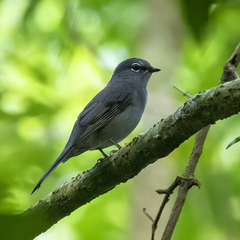
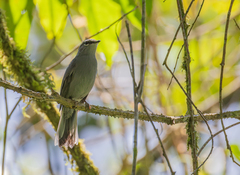
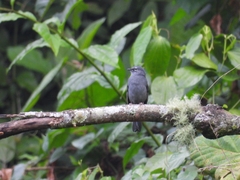
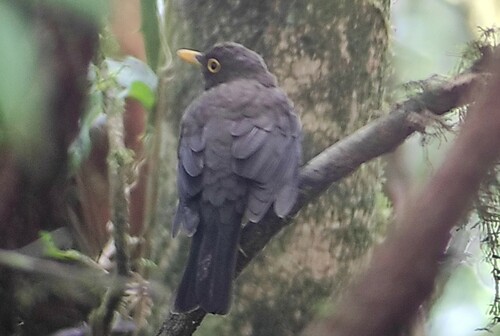
Slate-colored Solitaire

Slate-colored Solitaire

Myadestes unicolor

Silhouette: Francesco "Architetto" Rollandin · PhyloPic

LCLeast ConcernNTVUENCR
Daily sighting probability <5% · Rare
at Pico Bonito National Park

In 3 days <5% in a week ~10%

8 Verified sightings at Pico Bonito National Park From 2019 to 2026
488 In all 4 parks
December Best month
☀️ Diurnal When it's spotted

About the Slate-colored Solitaire

The slate-colored solitaire (Myadestes unicolor) is a species of bird in the family Turdidae, the thrushes. It is found in Belize, El Salvador, Guatemala, Honduras, Mexico, and Nicaragua. The slate-colored solitaire was originally described in 1857 as Myadestes unicolor and has retained that binomial since then. The slate-colored solitaire and the brown-backed solitaire (M. occidentalis) are sister species.

The slate-colored solitaire's further taxonomy is not settled. The IOC, AviList, and BirdLife International's Handbook of the Birds of the World treat it as monospecific. This article treats the slate-colored solitaire as monotypic.

The brown-backed solitaire is 19 to 20.5 cm (7.5 to 8.1 in) long and weighs 30 to 44 g (1.1 to 1.6 oz). The sexes have the same plumage. Adults are mostly slaty gray that is slightly lighter on their underparts than above. They have a broken white eye-ring, blacker primary coverts, black flight feathers with buff edges, and whitish gray outer tail feathers... Wikipedia →

Sounds

Song0:32

Mexico · 2024

© Richard E. Webster · XC927738 · CC BY-NC-SA 4.0

Call0:30

Honduras · 2015

© Mayron McKewy Mejía · XC297681 · CC BY-NC-SA 4.0

Song0:55

Guatemala · 2023

© Max Noack · XC791998 · CC BY-NC-SA 4.0

Global Distribution

Parks Where Found

# Park Country Daily sighting probability
1 La Tigra National Park 🇭🇳 Honduras
~50%
2 Cusuco National Park 🇭🇳 Honduras
~20%
3 Celaque National Park 🇭🇳 Honduras
~10%
4 Pico Bonito National Park 🇭🇳 Honduras
<5%

Before you go

What are the chances of seeing a Slate-colored Solitaire in Pico Bonito National Park?

Rare

Under 5% of wildlife watchers report a Slate-colored Solitaire sighting in Pico Bonito National Park on a given day, based on 8 verified sightings from GBIF citizen-science data from 2019 to 2026. It is the 253rd most-seen of the 271 birds we can rate there. Over three days the chance rises to under 5%, and over a week to about 10%, if each day is a fresh chance.

When is the best time to see a Slate-colored Solitaire in Pico Bonito National Park?

December

In that month about 10% of wildlife watchers report a Slate-colored Solitaire in Pico Bonito National Park on a given day, against under 5% in January to November, the lowest months. That is one of Pico Bonito National Park's wettest months, with about 290 mm of rain against 80 mm in April.

What time of day is best to see a Slate-colored Solitaire?

Between 8 and 11 am

Across all the parks we cover, that three-hour window holds the most Slate-colored Solitaire sightings with a recorded time, and about 8 in 10 of them come between 6 am and 6 pm: it is a daytime animal.

Is Pico Bonito National Park the best place to see a Slate-colored Solitaire?

4th of 4

Of the 4 parks where we can rate Slate-colored Solitaire sightings, Pico Bonito National Park ranks 4th at under 5%. The best odds are in La Tigra National Park (Honduras, about 50%), Cusuco National Park (Honduras, about 20%) and Celaque National Park (Honduras, about 10%).

Which relatives of the Slate-colored Solitaire live in Pico Bonito National Park?

Same family: Turdidae

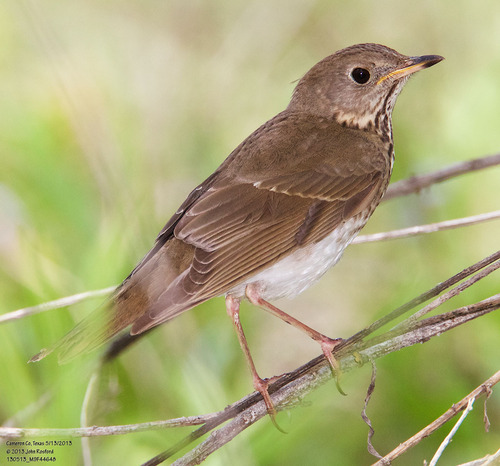
The closest relatives of the Slate-colored Solitaire that you can see in Pico Bonito National Park (family Turdidae, Thrushes) are Clay-colored Thrush (about 60%), Wood Thrush (about 40%) and Swainson's Thrush (about 10%), with each one's daily chance of a sighting.

Where does the Slate-colored Solitaire sighting chance come from?

GBIF citizen-science records

It is estimated from how often the Slate-colored Solitaire is recorded against all the birds logged in Pico Bonito National Park (8 verified sightings from 2019 to 2026), calibrated against known sighting rates. Figures are rounded to the nearest 10% because citizen-science data supports honest approximations, not decimals, and months with records from fewer than five people show "—". How it works.

← Back to Pico Bonito National Park