Plantation Glass Frog

Plantation Glass Frog

Hyalinobatrachium colymbiphyllum

Silhouette: Jose Carlos Arenas-Monroy · PhyloPic

LCLeast ConcernNTVUENCR
Daily sighting probability ~10% · With luck
at Piedras Blancas National Park

In 3 days ~30% in a week ~60%

6 Verified sightings at Piedras Blancas National Park From 2019 to 2026
6 In 1 park
September Best month
🌙 Nocturnal When it's spotted

About the Plantation Glass Frog

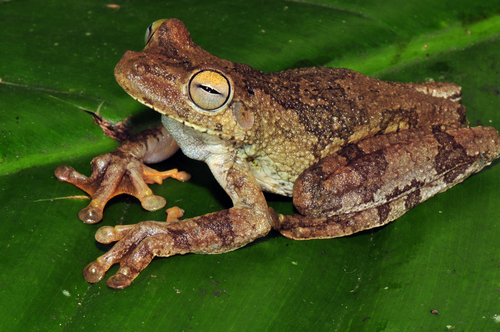
Hyalinobatrachium colymbiphyllum, also called the bare-hearted glass frog, plantation glass frog and the cricket glass frog, is a species of frog in the family Centrolenidae that is found in moist forests, often near streams, in countries in Central America and South America. They are small, green frogs with many similarities to other glass frogs, however, they have the most transparent undersides of any glass frogs. Their transparent undersides make them ideal bio-indicators for how global warming and other threats are affecting the animals in the forests.

Bare-hearted glass frogs are similar in features to most glass frogs but have their own distinct characteristics. Like most glass frogs, they are small and green with yellow spots and transparent undersides. The transparent undersides are the main feature of most glass frogs, but the bare-hearted glass frog has the clearest underside, allowing almost full visibility of their internal organs. Their transparent skin also makes them difficult to see, as well as their size. They are very small, with male frogs being 22–27 mm (0.87–1.06 in) long and females 24.5–29 mm (0.96–1.14 in) long. Other distinct characteristics... Wikipedia →

Sounds

Advertisement call0:22

Costa Rica · 2023

© Chris Harrison · XC893964 · CC BY-NC-SA 4.0

Recording0:13

Panama · 2026

© Brian Gratwicke · iNaturalist · CC BY 4.0

Global Distribution

Parks Where Found

# Park Country Daily sighting probability
1 Piedras Blancas National Park 🇨🇷 Costa Rica
~10%

More parks will be added in future updates.

Before you go

What are the chances of seeing a Plantation Glass Frog in Piedras Blancas National Park?

With luck

About 10% of wildlife watchers report a Plantation Glass Frog sighting in Piedras Blancas National Park on a given day, based on 6 verified sightings from GBIF citizen-science data from 2019 to 2026. It is the 31st most-seen of the 33 amphibians we can rate there. Over three days the chance rises to about 30%, and over a week to about 60%, if each day is a fresh chance.

When is the best time to see a Plantation Glass Frog in Piedras Blancas National Park?

September

In that month about 30% of wildlife watchers report a Plantation Glass Frog in Piedras Blancas National Park on a given day, against under 5% in February, April–July, October and December, the lowest months.

What time of day is best to see a Plantation Glass Frog?

Between 8 and 11 pm

Across all the parks we cover, that three-hour window holds the most Plantation Glass Frog sightings with a recorded time, and about 9 in 10 of them come between 6 pm and 6 am: it is mostly seen at night.

Where else can you see a Plantation Glass Frog?

Only Piedras Blancas National Park, in our data

Piedras Blancas National Park is the only park on Wallace's Line with enough records to rate Plantation Glass Frog sightings: about 10% of wildlife watchers there report one on a given day.

Where does the Plantation Glass Frog sighting chance come from?

GBIF citizen-science records

It is estimated from how often the Plantation Glass Frog is recorded against all the amphibians logged in Piedras Blancas National Park (6 verified sightings from 2019 to 2026), calibrated against known sighting rates. Figures are rounded to the nearest 10% because citizen-science data supports honest approximations, not decimals, and months with records from fewer than five people show "—". How it works.

← Back to Piedras Blancas National Park