
Black Mamba

Black Mamba

Dendroaspis polylepis

Silhouette: SeismicShrimp · PhyloPic

LCLeast ConcernNTVUENCR
Daily sighting probability ~10% · With luck
at Pilanesberg National Park

In 3 days ~30% in a week ~50%

6 Verified sightings at Pilanesberg National Park From 2019 to 2026
36 In all 2 parks
December Best month
☀️ Diurnal When it's spotted

About the Black Mamba

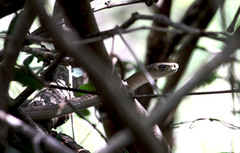
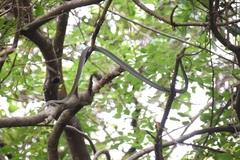
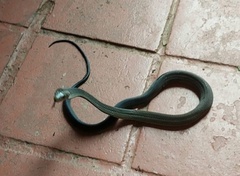
The black mamba (Dendroaspis polylepis) is a species of highly venomous snake belonging to the family Elapidae. It is native to parts of sub-Saharan Africa. First formally described by Albert Günther in 1864, it is the second-longest venomous snake after the king cobra; mature specimens generally exceed 2 m (6 ft 7 in) and commonly grow to 3 m (9.8 ft). Specimens of 4.3 to 4.5 m (14 to 15 ft) have been reported. It varies in colour from grey to dark brown. Juvenile black mambas tend to be more pale in colour than adults, and darken with age. Despite the common name, the black mamba is not black; the colour name describes rather the inside of its mouth, which it displays when feeling threatened.

The species is both terrestrial (ground-living) and arboreal (tree-living); it inhabits savannah, woodland, rocky slopes and in some regions, dense forest. It is diurnal and is known to prey on birds and small mammals. Over suitable surfaces, it can move at speeds up to 16 km/h (10 mph) for short distances. Adult black mambas have few natural predators.

In a threat display, the black mamba usually opens its inky-black mouth, spreads its narrow neck-flap and sometimes hisses. It is capable of striking at considerable range and may deliver a series of bites in rapid succession. Its venom is primarily composed of neurotoxins that often induce symptoms within ten minutes, and is frequently fatal unless antivenom is administered. Despite its reputation as a formidable and highly aggressive species, the black mamba attacks humans only if it is threatened or cornered. It is rated as least concern on the International Union for Conservation of Nature (IUCN)'s Red List of Threatened Species. Wikipedia →

Global Distribution

Parks Where Found

# Park Country Daily sighting probability
1 Pilanesberg National Park 🇿🇦 South Africa
~10%
2 Kruger National Park 🇿🇦 South Africa
~10%

Cities Where Found

# City Country Daily sighting probability
1 Durban 🇿🇦 South Africa
~10%

Zoos & Centres Where Found

# Zoo / Centre Country
1 Cabarceno Natural Park 🇪🇸 Spain In captivity
2 Kolmården Wildlife Park 🇸🇪 Sweden In captivity
3 Zoo Pilsen 🇨🇿 Czechia In captivity
4 Abilene Zoological Gardens 🇺🇸 United States In captivity
5 Haller Park 🇰🇪 Kenya In captivity
6 Sedgwick County Zoo 🇺🇸 United States In captivity
7 Omaha’s Henry Doorly Zoo and Aquarium 🇺🇸 United States In captivity
8 Johannesburg Zoo 🇿🇦 South Africa In captivity
9 Saint Louis Zoo 🇺🇸 United States In captivity
10 Terra Natura Benidorm 🇪🇸 Spain In captivity
11 Indianapolis Zoo 🇺🇸 United States In captivity
12 Houston Zoo 🇺🇸 United States In captivity
13 ABQ BioPark Zoo 🇺🇸 United States In captivity
14 London Zoo 🇬🇧 United Kingdom In captivity
15 Faunia 🇪🇸 Spain In captivity
16 The Abilene Zoo 🇺🇸 United States In captivity
17 Alligator Adventure 🇺🇸 United States In captivity
18 Reptile Gardens 🇺🇸 United States In captivity
19 Montecasino Bird Gardens 🇿🇦 South Africa In captivity
20 Hartbeespoort Dam Snake and Animal Park 🇿🇦 South Africa In captivity
21 Lawnwood snake sanctuary 🇿🇦 South Africa In captivity
22 Terrariet 🇩🇰 Denmark In captivity
23 iZoo 🇯🇵 Japan In captivity
24 Kentucky Reptile Zoo 🇺🇸 United States In captivity

Before you go

What are the chances of seeing a Black Mamba in Pilanesberg National Park?

With luck

About 10% of wildlife watchers report a Black Mamba sighting in Pilanesberg National Park on a given day, based on 6 verified sightings from GBIF citizen-science data from 2019 to 2026. It is the 10th most-seen of the 13 reptiles we can rate there. Over three days the chance rises to about 30%, and over a week to about 50%, if each day is a fresh chance.

When is the best time to see a Black Mamba in Pilanesberg National Park?

October and December

In those months about 20% of wildlife watchers report a Black Mamba in Pilanesberg National Park on a given day, against under 5% in January–April, July, September and November, the lowest months. Those are among Pilanesberg National Park's wettest months, with about 85 mm of rain a month against almost none in August.

What time of day is best to see a Black Mamba?

Between 10 am and 1 pm

Across all the parks we cover, that three-hour window holds the most Black Mamba sightings with a recorded time, and about 9 in 10 of them come between 6 am and 6 pm: it is a daytime animal.

Is Pilanesberg National Park the best place to see a Black Mamba?

Yes

Of the 2 parks where we can rate Black Mamba sightings, Pilanesberg National Park has the highest daily chance: about 10%. Next come Kruger National Park (South Africa, about 10%).

Where does the Black Mamba sighting chance come from?

GBIF citizen-science records

It is estimated from how often the Black Mamba is recorded against all the reptiles logged in Pilanesberg National Park (6 verified sightings from 2019 to 2026), calibrated against known sighting rates. Figures are rounded to the nearest 10% because citizen-science data supports honest approximations, not decimals, and months with records from fewer than five people show "—". How it works.

← Back to Pilanesberg National Park