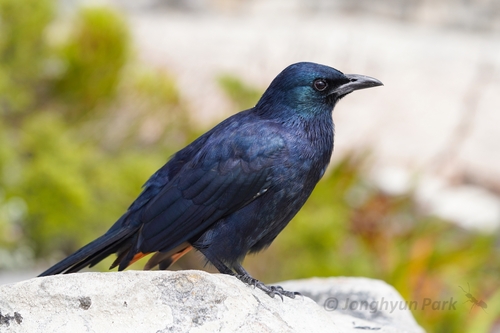
Karoo Thrush

Karoo Thrush

Turdus smithi

Silhouette: Sharon Wegner-Larsen · PhyloPic

LCLeast ConcernNTVUENCR
Daily sighting probability ~20% · Possible
at Pilanesberg National Park

In 3 days ~40% in a week ~70%

67 Verified sightings at Pilanesberg National Park From 2019 to 2026
139 In all 5 parks
September Best month
☀️ Diurnal When it's spotted

About the Karoo Thrush

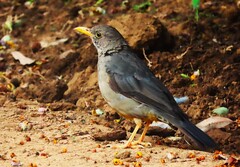
The Karoo thrush (Turdus smithi), also known as Smith's thrush, is a member of the thrush family in Africa. It has traditionally been considered a subspecies of the olive thrush (with which it is known to hybridize), but is increasingly treated as a separate species. The specific name honours the Scottish military surgeon and zoologist Sir Andrew Smith.

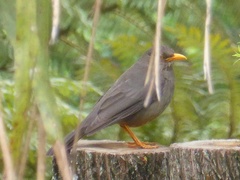
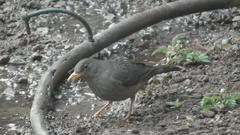
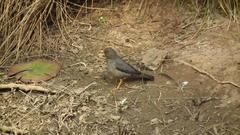
This medium-sized bird has a length of about 24 cm. It has a wing length between 117 and 131 mm, a culmen length between 20 and 24 mm and a tarsus length between 30.0 and 34.5 mm. It can reach a mass of at least 86 g. It differs from the olive thrush by its longer, entirely yellow bill, its longer wings, and its greyer flanks.

It occurs in South Africa, where it is present in Little Namaqualand, the Karoo and Northern Cape, Free State, Gauteng, Limpopo, Mpumalanga and parts of the North West Province. Bo T Bonnevie, The biology of suburban Olive Thrushes (Turdus olivaceus olivaceus) in the Eastern Cape, South Africa (2005). M.Sc. thesis, Rhodes University, South Africa

Olive/Karoo Thrush identification Birds of Southern Africa - Karoo Thrush Wikipedia →

Sounds

Song1:11

South Africa · 2026

© JJSUN · XC1072476 · CC BY-NC-SA 4.0

Dawn song0:49

South Africa · 2021

© Ehren Eksteen · XC773384 · CC BY-NC-SA 4.0

Begging call1:14

South Africa · 2004

© Nature sounds by Simply Birding · XC751161 · CC BY-NC-ND 4.0

Global Distribution

Parks Where Found

# Park Country Daily sighting probability
1 Golden Gate Highlands National Park 🇿🇦 South Africa
~30%
2 Pilanesberg National Park 🇿🇦 South Africa
~20%
3 West Coast National Park 🇿🇦 South Africa
<5%
4 Addo Elephant National Park 🇿🇦 South Africa
<5%
5 Kruger National Park 🇿🇦 South Africa
<5%

Cities Where Found

# City Country Daily sighting probability
1 Pretoria 🇿🇦 South Africa
~70%
2 Johannesburg 🇿🇦 South Africa
~70%

Zoos & Centres Where Found

# Zoo / Centre Country
1 National Zoological Garden of South Africa 🇿🇦 South Africa In captivity

Before you go

What are the chances of seeing a Karoo Thrush in Pilanesberg National Park?

Possible

About 20% of wildlife watchers report a Karoo Thrush sighting in Pilanesberg National Park on a given day, based on 67 verified sightings from GBIF citizen-science data from 2019 to 2026. It is the 81st most-seen of the 233 birds we can rate there. Over three days the chance rises to about 40%, and over a week to about 70%, if each day is a fresh chance.

When is the best time to see a Karoo Thrush in Pilanesberg National Park?

September

In that month about 30% of wildlife watchers report a Karoo Thrush in Pilanesberg National Park on a given day, against about 10% in April, July and November–February, the lowest months. That is one of Pilanesberg National Park's driest months, with about 5 mm of rain against 130 mm in December.

What time of day is best to see a Karoo Thrush?

Between 7 and 10 am

Across all the parks we cover, that three-hour window holds the most Karoo Thrush sightings with a recorded time, and about 9 in 10 of them come between 6 am and 6 pm: it is a daytime animal.

Is Pilanesberg National Park the best place to see a Karoo Thrush?

2nd of 5

Of the 5 parks where we can rate Karoo Thrush sightings, Pilanesberg National Park ranks 2nd at about 20%. The best odds are in Golden Gate Highlands National Park (South Africa, about 30%).

Where does the Karoo Thrush sighting chance come from?

GBIF citizen-science records

It is estimated from how often the Karoo Thrush is recorded against all the birds logged in Pilanesberg National Park (67 verified sightings from 2019 to 2026), calibrated against known sighting rates. Figures are rounded to the nearest 10% because citizen-science data supports honest approximations, not decimals, and months with records from fewer than five people show "—". How it works.

← Back to Pilanesberg National Park