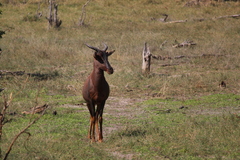
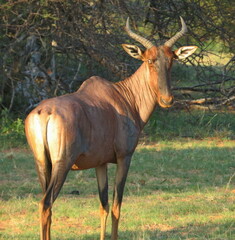
Tsessebe

Tsessebe

Damaliscus lunatus

Silhouette: [unknown] · PhyloPic

LCLeast ConcernNTVUENCR
Daily sighting probability ~30% · Possible
at Pilanesberg National Park

In 3 days ~70% in a week ~90%

78 Verified sightings at Pilanesberg National Park From 2019 to 2026
362 In all 5 parks
December Best month
☀️ Diurnal When it's spotted

About the Tsessebe

Damaliscus lunatus is a large African antelope of the genus Damaliscus and subfamily Alcelaphinae in the family Bovidae, with a number of recognised geographic subspecies. Some authorities have split the different populations of the species into different species, although this is seen as controversial. Common names include topi, sassaby (formerly also sassayby), tiang and tsessebe.

The word tope or topi is Swahili, and was first recorded by the German explorer Gustav Fischer on the ancient city island of Lamu off the Kenyan coast. Other names recorded in East Africa by various German explorers were mhili in Kisukuma and jimäla in Kinyamwezi. The Luganda name was simäla according to Neumann, or nemira according to Lugard.

The first thing published about this antelope was the afore-mentioned painting of a young male sassayby by Daniell from 1820, but the first scientific description was by William John Burchell in 1824. In 1812 hunters attached to Burchell's expedition shot a female animal in what is now Free State, in what is thought to be the southernmost part of its range. Burchell named it the "crescent-horned antelope", Antilope lunata. Burchell had... Wikipedia →

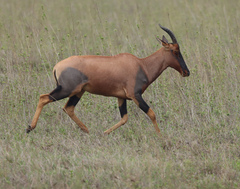
Global Distribution

Parks Where Found

# Park Country Daily sighting probability
1 Moremi Game Reserve 🇧🇼 Botswana
~50%
2 Pilanesberg National Park 🇿🇦 South Africa
~30%
3 Chobe National Park 🇧🇼 Botswana
~30%
4 Kruger National Park 🇿🇦 South Africa
~20%
5 iSimangaliso Wetland Park 🇿🇦 South Africa
~10%

Before you go

What are the chances of seeing a Tsessebe in Pilanesberg National Park?

Possible

About 30% of wildlife watchers report a Tsessebe sighting in Pilanesberg National Park on a given day, based on 78 verified sightings from GBIF citizen-science data from 2019 to 2026. It is the 16th most-seen of the 31 mammals we can rate there. Over three days the chance rises to about 70%, and over a week to about 90%, if each day is a fresh chance.

When is the best time to see a Tsessebe in Pilanesberg National Park?

February, August–September and November–December

In those months about 40% of wildlife watchers report a Tsessebe in Pilanesberg National Park on a given day, against about 20% in January, March and May, the lowest months.

What time of day is best to see a Tsessebe?

Between 7 and 10 am

Across all the parks we cover, that three-hour window holds the most Tsessebe sightings with a recorded time, and about 9 in 10 of them come between 6 am and 6 pm: it is a daytime animal.

Is Pilanesberg National Park the best place to see a Tsessebe?

2nd of 5

Of the 5 parks where we can rate Tsessebe sightings, Pilanesberg National Park ranks 2nd at about 30%. The best odds are in Moremi Game Reserve (Botswana, about 50%). All parks ranked.

Which relatives of the Tsessebe live in Pilanesberg National Park?

Same family: Bovidae

The closest relatives of the Tsessebe that you can see in Pilanesberg National Park (family Bovidae, Bovids) are Impala (about 60%), Blue Wildebeest (about 60%) and Greater Kudu (about 50%), with each one's daily chance of a sighting.

Where does the Tsessebe sighting chance come from?

GBIF citizen-science records

It is estimated from how often the Tsessebe is recorded against all the mammals logged in Pilanesberg National Park (78 verified sightings from 2019 to 2026), calibrated against known sighting rates. Figures are rounded to the nearest 10% because citizen-science data supports honest approximations, not decimals, and months with records from fewer than five people show "—". How it works.

← Back to Pilanesberg National Park