Olivaceous Greenlet

Olivaceous Greenlet

Hylophilus olivaceus

Silhouette: Sheatherius · PhyloPic

LCLeast ConcernNTVUENCR
Daily sighting probability ~10% · With luck
at Podocarpus National Park

In 3 days ~20% in a week ~50%

141 Verified sightings at Podocarpus National Park From 2019 to 2026
141 In 1 park
January Best month
☀️ Diurnal When it's spotted

About the Olivaceous Greenlet

The olivaceous greenlet (Hylophilus olivaceus) is a species of bird in the family Vireonidae, the vireos, greenlets, and shrike-babblers. It is found in Ecuador and Peru. In the mid-twentieth century at least one author considered the olivaceous greenlet to be a subspecies of the scrub greenlet (Hylophilus flavipes). However, later work showed they are not closely related but that the olivaceous and ashy-headed (H. pectoralis) greenlets are sister species.

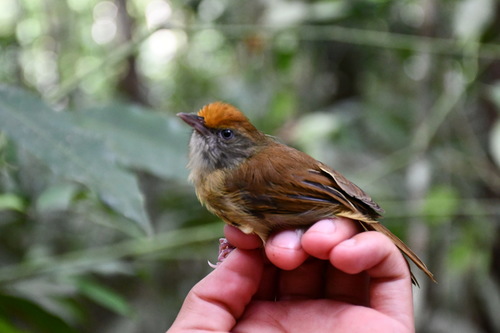
The olivaceous greenlet is monotypic. The olivaceeous greenlet is 12 cm (4.7 in) long and weighs 11 to 13 g (0.39 to 0.46 oz). The sexes have the same plumage. Adults have a yellowish olive forehead. The rest of the top of their head and their upperparts, wings, and tail are dull olive-green. Their underparts are yellowish olive that is slightly lighter on the chin and a slightly brighter yellow on the belly. They have a whitish iris, a dull pink or brownish pink bill, and brownish pink legs and feet.

The olivaceous greenlet has a disjunct distribution on the eastern slope of the Andes. It is found in Ecuador from Napo Province south almost to the Peruvian... Wikipedia →

Sounds

Song0:52

Peru · 2022

© Guilherme Melo Becher · XC771320 · CC BY-NC-SA 4.0

Song0:26

Peru · 2013

© Fabrice Schmitt · XC543141 · CC BY-NC-SA 4.0

Song0:25

Peru · 2015

© Ross Gallardy · XC296708 · CC BY-NC-SA 4.0

Global Distribution

Parks Where Found

# Park Country Daily sighting probability
1 Podocarpus National Park 🇪🇨 Ecuador
~10%

More parks will be added in future updates.

Before you go

What are the chances of seeing an Olivaceous Greenlet in Podocarpus National Park?

With luck

About 10% of wildlife watchers report an Olivaceous Greenlet sighting in Podocarpus National Park on a given day, based on 141 verified sightings from GBIF citizen-science data from 2019 to 2026. It is the 141st most-seen of the 446 birds we can rate there. Over three days the chance rises to about 20%, and over a week to about 50%, if each day is a fresh chance.

When is the best time to see an Olivaceous Greenlet in Podocarpus National Park?

January and May

In those months about 20% of wildlife watchers report an Olivaceous Greenlet in Podocarpus National Park on a given day, against under 5% in February, June, September and November, the lowest months.

What time of day is best to see an Olivaceous Greenlet?

Between 10 am and 1 pm

Across all the parks we cover, that three-hour window holds the most Olivaceous Greenlet sightings with a recorded time, and nearly all of them come between 6 am and 6 pm: it is a daytime animal.

Where else can you see an Olivaceous Greenlet?

Only Podocarpus National Park, in our data

Podocarpus National Park is the only park on Wallace's Line with enough records to rate Olivaceous Greenlet sightings: about 10% of wildlife watchers there report one on a given day.

Where does the Olivaceous Greenlet sighting chance come from?

GBIF citizen-science records

It is estimated from how often the Olivaceous Greenlet is recorded against all the birds logged in Podocarpus National Park (141 verified sightings from 2019 to 2026), calibrated against known sighting rates. Figures are rounded to the nearest 10% because citizen-science data supports honest approximations, not decimals, and months with records from fewer than five people show "—". How it works.

← Back to Podocarpus National Park