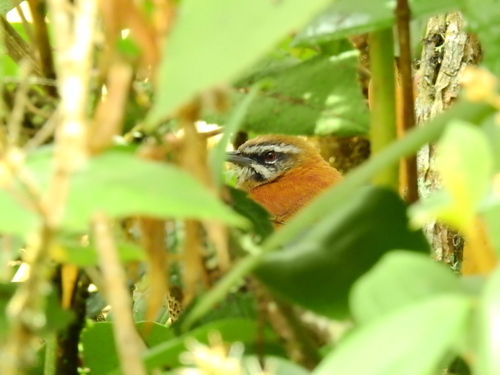
Turquoise Jay

Turquoise Jay

Cyanolyca turcosa

Silhouette: Sheatherius · PhyloPic

LCLeast ConcernNTVUENCR
Daily sighting probability ~20% · Possible
at Podocarpus National Park

In 3 days ~50% in a week ~80%

298 Verified sightings at Podocarpus National Park From 2019 to 2026
298 In 1 park
November Best month
☀️ Diurnal When it's spotted

About the Turquoise Jay

The turquoise jay (Cyanolyca turcosa) is a species of bird in the family Corvidae. The turquoise jay is a vibrant blue jay with a black face mask and collar. It is found exclusively in South America throughout southern Colombia, Ecuador, and northern Peru. The turquoise jay prefers a humid habitat of montane evergreen forest and elfin forest with both primary and secondary growth. This bird is omnivorous and is known to eat insects, berries, eggs, and young birds of other species. Turquoise jays are nonmigratory and tend to travel in mixed flocks.

The order Passeriformes, commonly referred to as "perching birds", is the largest and most diverse order of birds. These birds are found worldwide, excluding Antarctica, but have their highest concentration in the tropics. Their sizes range from just a few grams to over a kilogram in weight, and they are generally colorful songbirds.

The family Corvidae is in the order Passeriformes and includes the jays, magpies, and crows. Most of the birds are strongly built, are stout-billed, and are some of the largest birds in Passeriformes. In most cases there exists no sexual dimorphism. Corvids have loud, harsh... Wikipedia →

Sounds

Call0:29

Ecuador · 2025

© Manuel Sánchez-Nivicela · XC1152005 · CC BY-NC-ND 4.0

Song0:28

Ecuador · 2024

© Barry Edmonston · XC1001474 · CC BY-NC-SA 4.0

Flight call0:16

Ecuador · 2006

© Olaf Jahn · XC262335 · CC BY-NC-SA 4.0

Global Distribution

Parks Where Found

# Park Country Daily sighting probability
1 Podocarpus National Park 🇪🇨 Ecuador
~20%

More parks will be added in future updates.

Before you go

What are the chances of seeing a Turquoise Jay in Podocarpus National Park?

Possible

About 20% of wildlife watchers report a Turquoise Jay sighting in Podocarpus National Park on a given day, based on 298 verified sightings from GBIF citizen-science data from 2019 to 2026. It is the 61st most-seen of the 446 birds we can rate there. Over three days the chance rises to about 50%, and over a week to about 80%, if each day is a fresh chance.

When is the best time to see a Turquoise Jay in Podocarpus National Park?

November and December

In those months about 30% of wildlife watchers report a Turquoise Jay in Podocarpus National Park on a given day, against about 10% in January–February and October, the lowest months.

What time of day is best to see a Turquoise Jay?

Between 6 and 9 am

Across all the parks we cover, that three-hour window holds the most Turquoise Jay sightings with a recorded time, and about 8 in 10 of them come between 6 am and 6 pm: it is a daytime animal.

Where else can you see a Turquoise Jay?

Only Podocarpus National Park, in our data

Podocarpus National Park is the only park on Wallace's Line with enough records to rate Turquoise Jay sightings: about 20% of wildlife watchers there report one on a given day.

Where does the Turquoise Jay sighting chance come from?

GBIF citizen-science records

It is estimated from how often the Turquoise Jay is recorded against all the birds logged in Podocarpus National Park (298 verified sightings from 2019 to 2026), calibrated against known sighting rates. Figures are rounded to the nearest 10% because citizen-science data supports honest approximations, not decimals, and months with records from fewer than five people show "—". How it works.

← Back to Podocarpus National Park