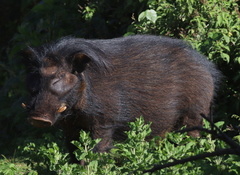
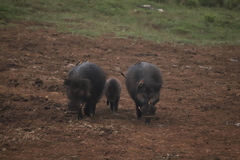
Giant Forest Hog

Giant Forest Hog

Hylochoerus meinertzhageni

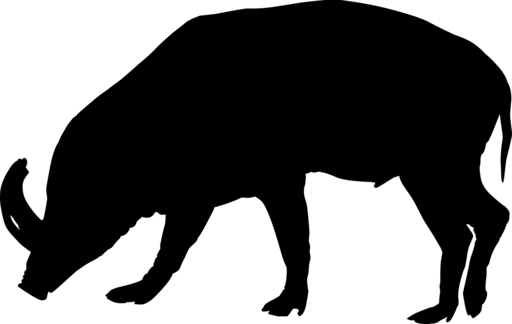
Silhouette: T. Michael Keesey (after Masteraah) · PhyloPic

LCLeast ConcernNTVUENCR
Daily sighting probability ~50% · Likely
at Queen Elizabeth National Park

In 3 days ~90% in a week >90%

66 Verified sightings at Queen Elizabeth National Park From 2019 to 2026
125 In all 2 parks
January Best month
☀️ Diurnal When it's spotted

About the Giant Forest Hog

The giant forest hog (Hylochoerus meinertzhageni), the only member of its genus (Hylochoerus), is native to wooded habitats in Africa and is one of the largest wild members of the pig family, Suidae, along with a few subspecies of the wild boar. It was first described in 1904. The specific name honours Richard Meinertzhagen, who shot the type specimen in Kenya and had it shipped to the Natural History Museum in England.

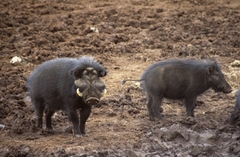
The giant forest hog is, on average, the largest living species of suid. Adults can measure from 1.3 to 2.1 m (4 ft 3 in to 6 ft 11 in) in head-and-body length, with an additional tail length of 25 to 45 cm (9.8 to 17.7 in). Adults stand 0.75 to 1.1 m (2 ft 6 in to 3 ft 7 in) in height at the shoulder, and can weigh from 100 to 275 kg (220 to 606 lb). Females are smaller than males. Females weigh a median of approximately 167 kg (368 lb), as opposed to males, which weigh a median of 210 kg (460 lb). Wikipedia →

Global Distribution

Parks Where Found

# Park Country Daily sighting probability
1 Aberdare National Park 🇰🇪 Kenya
~80%
2 Queen Elizabeth National Park 🇺🇬 Uganda
~50%

Before you go

What are the chances of seeing a Giant Forest Hog in Queen Elizabeth National Park?

Likely

About 50% of wildlife watchers report a Giant Forest Hog sighting in Queen Elizabeth National Park on a given day, based on 66 verified sightings from GBIF citizen-science data from 2019 to 2026. It is the 9th most-seen of the 24 mammals we can rate there. Over three days the chance rises to about 90%, and over a week to over 90%, if each day is a fresh chance.

When is the best time to see a Giant Forest Hog in Queen Elizabeth National Park?

January

In that month about 70% of wildlife watchers report a Giant Forest Hog in Queen Elizabeth National Park on a given day, against about 10% in April and November, the lowest months. That is one of Queen Elizabeth National Park's driest months, with about 15 mm of rain against 150 mm in April.

What time of day is best to see a Giant Forest Hog?

Between 2 and 5 pm

Across all the parks we cover, that three-hour window holds the most Giant Forest Hog sightings with a recorded time, and about 9 in 10 of them come between 6 am and 6 pm: it is a daytime animal.

Is Queen Elizabeth National Park the best place to see a Giant Forest Hog?

2nd of 2

Of the 2 parks where we can rate Giant Forest Hog sightings, Queen Elizabeth National Park ranks 2nd at about 50%. The best odds are in Aberdare National Park (Kenya, about 80%).

Where does the Giant Forest Hog sighting chance come from?

GBIF citizen-science records

It is estimated from how often the Giant Forest Hog is recorded against all the mammals logged in Queen Elizabeth National Park (66 verified sightings from 2019 to 2026), calibrated against known sighting rates. Figures are rounded to the nearest 10% because citizen-science data supports honest approximations, not decimals, and months with records from fewer than five people show "—". How it works.

← Back to Queen Elizabeth National Park