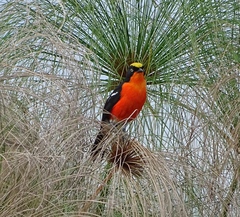
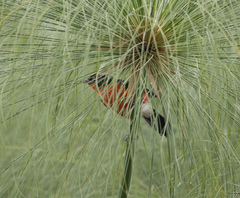
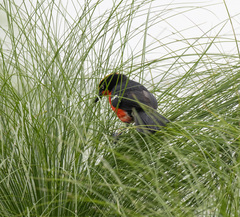
Papyrus Gonolek

Papyrus Gonolek

Laniarius mufumbiri

Silhouette: Sheatherius · PhyloPic

LCNTNear ThreatenedVUENCR
Daily sighting probability ~10% · With luck
at Queen Elizabeth National Park

In 3 days ~40% in a week ~70%

228 Verified sightings at Queen Elizabeth National Park From 2019 to 2026
464 In all 6 parks
November Best month

About the Papyrus Gonolek

The papyrus gonolek (Laniarius mufumbiri) is a species of bird in the family Malaconotidae. It is found in Burundi, Democratic Republic of the Congo, Kenya, Rwanda, Tanzania, and Uganda. It has specialised habitat requirements, being restricted to papyrus swamps. Not yet a threatened species, it has become rare due to habitat loss and pollution.

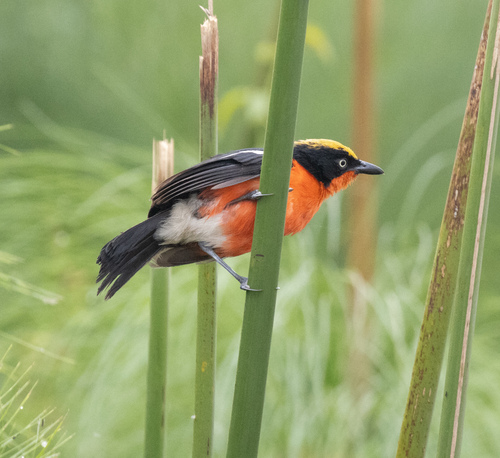
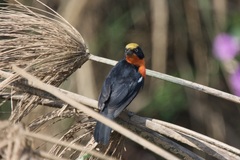
The papyrus gonolek is a medium-sized bush-shrike some 18 cm (7 in) long. The sexes are similar; the crown is dull yellow, the head, upper parts, wings and tail are black apart from a broad white bar on the wings. The breast and upper belly are vivid orange-crimson, and the lower belly whitish.

This species is difficult to observe and has been little studied. It occurs singly or in pairs in papyrus swamps, lurking among the vegetation and only flying occasionally, usually a short distance over water to another patch of papyrus. Its presence can often be detected by its calls, which consist of brief whistles and grating tearing sounds which have been rendered as "U-tzeu-U-tzee". Sometimes two birds duet. The diet consists mainly of insects such as beetles, flies and ants, but also includes snails, fruit and seeds... Wikipedia →
Sounds

Call0:38

Uganda · 2025

© Bernard BOUSQUET · XC1063889 · CC BY-NC-SA 4.0

Song0:45

Uganda · 2018

© Andrew Spencer · XC430504 · CC BY-NC-ND 4.0

Duet0:09

Rwanda · 2010

© Jason Anderson · XC75924 · CC BY-NC-ND 2.5

Global Distribution

Parks Where Found

# Park Country Daily sighting probability
1 Queen Elizabeth National Park 🇺🇬 Uganda
~10%
2 Lake Mburo National Park 🇺🇬 Uganda
~10%
3 Kibale National Park 🇺🇬 Uganda
~10%
4 Akagera National Park 🇷🇼 Rwanda
<5%
5 Murchison Falls National Park 🇺🇬 Uganda
<5%
6 Virunga National Park 🇨🇩 Democratic Republic of the Congo
<5%

Cities Where Found

# City Country Daily sighting probability
1 Kigali 🇷🇼 Rwanda
<5%
2 Kampala 🇺🇬 Uganda
<5%

Before you go

What are the chances of seeing a Papyrus Gonolek in Queen Elizabeth National Park?

With luck

About 10% of wildlife watchers report a Papyrus Gonolek sighting in Queen Elizabeth National Park on a given day, based on 228 verified sightings from GBIF citizen-science data from 2019 to 2026. It is the 120th most-seen of the 434 birds we can rate there. Over three days the chance rises to about 40%, and over a week to about 70%, if each day is a fresh chance.

When is the best time to see a Papyrus Gonolek in Queen Elizabeth National Park?

February, May, July and November–December

In those months about 20% of wildlife watchers report a Papyrus Gonolek in Queen Elizabeth National Park on a given day, against about 10% in January, March–April, June and August–October, the lowest months.

Is Queen Elizabeth National Park the best place to see a Papyrus Gonolek?

Yes

Of the 6 parks where we can rate Papyrus Gonolek sightings, Queen Elizabeth National Park has the highest daily chance: about 10%. Next come Lake Mburo National Park (Uganda, about 10%) and Kibale National Park (Uganda, about 10%).

Which relatives of the Papyrus Gonolek live in Queen Elizabeth National Park?

Same genus: Laniarius

The closest relatives of the Papyrus Gonolek that you can see in Queen Elizabeth National Park (genus Laniarius, Boubous and Gonoleks) are Black-headed Gonolek (about 70%) and Tropical Boubou (about 10%), with each one's daily chance of a sighting.

Where does the Papyrus Gonolek sighting chance come from?

GBIF citizen-science records

It is estimated from how often the Papyrus Gonolek is recorded against all the birds logged in Queen Elizabeth National Park (228 verified sightings from 2019 to 2026), calibrated against known sighting rates. Figures are rounded to the nearest 10% because citizen-science data supports honest approximations, not decimals, and months with records from fewer than five people show "—". How it works.

← Back to Queen Elizabeth National Park