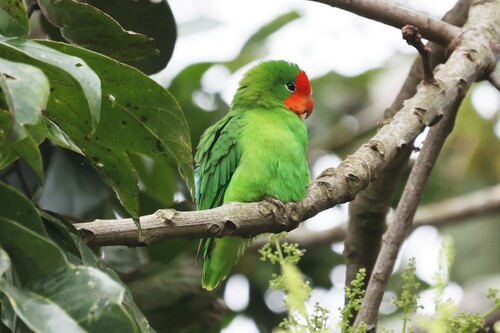
Red-headed Lovebird

Red-headed Lovebird

Agapornis pullarius

Silhouette: Hugo Gruson · PhyloPic

LCLeast ConcernNTVUENCR
Daily sighting probability ~10% · With luck
at Queen Elizabeth National Park

In 3 days ~20% in a week ~40%

114 Verified sightings at Queen Elizabeth National Park From 2019 to 2026
509 In all 4 parks
May Best month

About the Red-headed Lovebird

The red-headed lovebird (Agapornis pullarius), also known as the red-faced lovebird, is a member of the genus Agapornis, a group commonly known as lovebirds. Like other lovebirds, it is native to Africa. The red-headed lovebird was formally described in 1758 by the Swedish naturalist Carl Linnaeus in the tenth edition of his Systema Naturae. He placed it with all the other parrots in the genus Psittacus and coined the binomial name Psittacus pullarius. The type locality is Ghana. The red-headed lovebird is now one of nine species placed in the genus Agapornis that was introduced in 1836 by the English naturalist Prideaux John Selby. The genus name combines the Ancient Greek ἀγάπη agápē meaning "love" and ὄρνις órnis meaning "bird". The specific epithet pullārius is from Latin and means "of young birds" (pullus means "chick").

Two subspecies are recognised: It has a well demarcated red area on its head extending... Wikipedia →

Sounds

Call0:07

Cameroon · 1997

© selvino · XC156364 · CC BY-NC-SA 3.0

Global Distribution

Parks Where Found

# Park Country Daily sighting probability
1 Lake Mburo National Park 🇺🇬 Uganda
~30%
2 Virunga National Park 🇨🇩 Democratic Republic of the Congo
~10%
3 Queen Elizabeth National Park 🇺🇬 Uganda
~10%
4 Murchison Falls National Park 🇺🇬 Uganda
<5%

Cities Where Found

# City Country Daily sighting probability
1 Brazzaville 🇨🇬 Republic of the Congo
~10%
2 Abuja 🇳🇬 Nigeria
~10%
3 Kampala 🇺🇬 Uganda
<5%

Before you go

What are the chances of seeing a Red-headed Lovebird in Queen Elizabeth National Park?

With luck

About 10% of wildlife watchers report a Red-headed Lovebird sighting in Queen Elizabeth National Park on a given day, based on 114 verified sightings from GBIF citizen-science data from 2019 to 2026. It is the 178th most-seen of the 434 birds we can rate there. Over three days the chance rises to about 20%, and over a week to about 40%, if each day is a fresh chance.

When is the best time to see a Red-headed Lovebird in Queen Elizabeth National Park?

April–May and November

In those months about 20% of wildlife watchers report a Red-headed Lovebird in Queen Elizabeth National Park on a given day, against under 5% in March, June, October and December–January, the lowest months. Those are among Queen Elizabeth National Park's wettest months, with about 130 mm of rain a month against 15 mm in January.

Is Queen Elizabeth National Park the best place to see a Red-headed Lovebird?

3rd of 4

Of the 4 parks where we can rate Red-headed Lovebird sightings, Queen Elizabeth National Park ranks 3rd at about 10%. The best odds are in Lake Mburo National Park (Uganda, about 30%) and Virunga National Park (Democratic Republic of the Congo, about 10%).

Where does the Red-headed Lovebird sighting chance come from?

GBIF citizen-science records

It is estimated from how often the Red-headed Lovebird is recorded against all the birds logged in Queen Elizabeth National Park (114 verified sightings from 2019 to 2026), calibrated against known sighting rates. Figures are rounded to the nearest 10% because citizen-science data supports honest approximations, not decimals, and months with records from fewer than five people show "—". How it works.

← Back to Queen Elizabeth National Park