



Completed



Yellow-eyed Penguin
Megadyptes antipodes
Silhouette: Steven Traver · PhyloPic
- KingdomAnimalia (Animals)
- PhylumChordata (Chordates)
- ClassAves (Birds)
- OrderSphenisciformes (Penguins)
- FamilySpheniscidae (Penguins)
- GenusMegadyptes (Yellow-eyed Penguins)
- SpeciesMegadyptes antipodes (Yellow-eyed Penguin)
In 3 days ~10% in a week ~30%
86 Verified sightings at Rakiura National Park From 2019 to 2026
86 In 1 park
May Best month
☀️🌙 Day & Night When it's spotted
About the Yellow-eyed Penguin
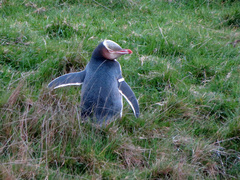
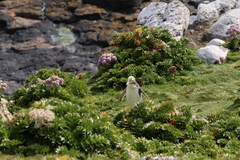
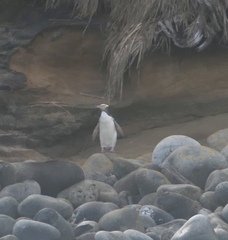
The yellow-eyed penguin (Megadyptes antipodes), known also as hoiho, is a species of penguin endemic to New Zealand. It is the sole extant species in the genus Megadyptes, from Ancient Greek μέγας (mégas), meaning "large", and δύπτης (dúptes), meaning "diver".
Previously thought closely related to the little penguin (Eudyptula minor), molecular research has shown it more closely related to penguins of the genus Eudyptes. Like most penguins, it is mainly piscivorous. The species breeds along the eastern and south-eastern coastlines of the South Island of New Zealand, as well as Stewart Island, Auckland Islands, and Campbell Islands. Colonies on the Otago Peninsula are a popular tourist venue, where visitors may closely observe penguins from hides, trenches, or tunnels.
On the New Zealand mainland, the species has experienced a significant decline over the past 20 years. On the Otago Peninsula, numbers have dropped by 75% since the mid-1990s and population trends indicate the possibility of regional extinction from the peninsula in the next 20 to 40 years. While the effect of rising ocean temperatures is still being studied, an infectious outbreak in the mid-2000s played a large role in the drop. Human activities at sea (fisheries, pollution) may have an equal if not greater influence on the species' downward trend. Wikipedia →
Sounds
Song0:58
New Zealand · 2013
© Fernand DEROUSSEN · XC152992 · CC BY-NC-ND 3.0
Song0:18
New Zealand · 2004
© Ryan Merrill · XC41930 · CC BY-NC-ND 2.5
Recording0:16
New Zealand · 2023
© Jenny Saito · iNaturalist · CC BY-NC 4.0
Recent sightings of Yellow-eyed Penguin in Rakiura National Park
LIVEiNaturalistGlobal Distribution
Parks Where Found
| # | Park | Country | Daily sighting probability |
|---|---|---|---|
| 1 | Rakiura National Park | 🇳🇿 New Zealand |
More parks will be added in future updates.
Closest Relatives at Rakiura National Park


Before you go
What are the chances of seeing a Yellow-eyed Penguin in Rakiura National Park?
With luck
About 10% of wildlife watchers report a Yellow-eyed Penguin sighting in Rakiura National Park on a given day, based on 86 verified sightings from GBIF citizen-science data from 2019 to 2026. It is the 50th most-seen of the 80 birds we can rate there. Over three days the chance rises to about 10%, and over a week to about 30%, if each day is a fresh chance.
When is the best time to see a Yellow-eyed Penguin in Rakiura National Park?
January–March, May and July
In those months about 10% of wildlife watchers report a Yellow-eyed Penguin in Rakiura National Park on a given day, against under 5% in April, June and August–December, the lowest months.
What time of day is best to see a Yellow-eyed Penguin?
Between 3 and 6 pm
Across all the parks we cover, that three-hour window holds the most Yellow-eyed Penguin sightings with a recorded time, and about 7 in 10 of them come between 6 am and 6 pm: it is seen both by day and at night.
Where else can you see a Yellow-eyed Penguin?
Only Rakiura National Park, in our data
Rakiura National Park is the only park on Wallace's Line with enough records to rate Yellow-eyed Penguin sightings: about 10% of wildlife watchers there report one on a given day.
Which relatives of the Yellow-eyed Penguin live in Rakiura National Park?
Same family: Spheniscidae
The closest relatives of the Yellow-eyed Penguin that you can see in Rakiura National Park (family Spheniscidae, Penguins) are Little Penguin (about 30%) and Fiordland Penguin (about 20%), with each one's daily chance of a sighting.
Where does the Yellow-eyed Penguin sighting chance come from?
GBIF citizen-science records
It is estimated from how often the Yellow-eyed Penguin is recorded against all the birds logged in Rakiura National Park (86 verified sightings from 2019 to 2026), calibrated against known sighting rates. Figures are rounded to the nearest 10% because citizen-science data supports honest approximations, not decimals, and months with records from fewer than five people show "—". How it works.
