
Meller's Duck

Meller's Duck

Anas melleri

Silhouette: Sheatherius · PhyloPic

LCNTVUENEndangeredCR
Daily sighting probability <5% · Rare
at Ranomafana National Park

In 3 days ~10% in a week ~20%

17 Verified sightings at Ranomafana National Park From 2019 to 2026
17 In 1 park
July Best month
☀️🌙 Day & Night When it's spotted

About the Meller's Duck

Meller's duck (Anas melleri) is a species of the dabbling duck genus Anas. It is endemic to eastern Madagascar. Although a population was established on Mauritius in the mid-18th century, this is on the verge of extinction due to habitat loss and competition by feral domestic ducks. The species name of this species is after the botanist Charles James Meller, and its generic name is from the Latin for "duck".

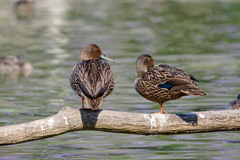
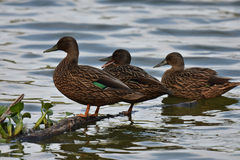
The Meller's duck resembles a large female mallard. At 55–65 centimetres (22–26 in), it averages slightly larger than a mallard and is at the top size for the genus Anas. However, as opposed to most mallard relatives, they lack a supercilium. The speculum feathers are green as in some of its relatives, but unlike in these, it is bordered white as in the mallard. Its body is dark brown with narrow paler fringes to feathers on upper parts and wider fringes on lower parts. Its bill is pale grey, with dark patches at the base, and is larger than normal. Its feet and legs are orange.

Meller's duck breeds apparently during most of the year except May–June on Madagascar, dependent on local conditions; the Mauritian population has been recorded to breed... Wikipedia →

Sounds

Call0:15

Madagascar · 2012

© Peter Boesman · XC762587 · CC BY-NC-ND 4.0

Flight call0:07

Madagascar · 2012

© Hans Matheve · XC155212 · CC BY-NC-ND 3.0

Call0:45

Madagascar · 2020

© Ken Behrens · XC623644 · CC BY-NC-SA 4.0

Global Distribution

Parks Where Found

# Park Country Daily sighting probability
1 Ranomafana National Park 🇲🇬 Madagascar
<5%

More parks will be added in future updates.

Cities Where Found

# City Country Daily sighting probability
1 Antananarivo 🇲🇬 Madagascar
~40%

Zoos & Centres Where Found

# Zoo / Centre Country
1 Lisbon Oceanarium 🇵🇹 Portugal In captivity
2 Zoo Pilsen 🇨🇿 Czechia In captivity
3 Parc Merveilleux 🇱🇺 Luxembourg In captivity
4 Lemur Island 🇲🇬 Madagascar In captivity
5 Bioparc Fuengirola 🇪🇸 Spain In captivity

Before you go

What are the chances of seeing a Meller's Duck in Ranomafana National Park?

Rare

Under 5% of wildlife watchers report a Meller's Duck sighting in Ranomafana National Park on a given day, based on 17 verified sightings from GBIF citizen-science data from 2019 to 2026. It is the 83rd most-seen of the 102 birds we can rate there. Over three days the chance rises to about 10%, and over a week to about 20%, if each day is a fresh chance.

When is the best time to see a Meller's Duck in Ranomafana National Park?

July and November–December

In those months about 10% of wildlife watchers report a Meller's Duck in Ranomafana National Park on a given day, against under 5% in February–May and August–October, the lowest months. January and June have too few records to rate.

What time of day is best to see a Meller's Duck?

Between 8 and 11 am

Across all the parks we cover, that three-hour window holds the most Meller's Duck sightings with a recorded time, and about 7 in 10 of them come between 6 am and 6 pm: it is seen both by day and at night.

Where else can you see a Meller's Duck?

Only Ranomafana National Park, in our data

Ranomafana National Park is the only park on Wallace's Line with enough records to rate Meller's Duck sightings: under 5% of wildlife watchers there report one on a given day.

Where does the Meller's Duck sighting chance come from?

GBIF citizen-science records

It is estimated from how often the Meller's Duck is recorded against all the birds logged in Ranomafana National Park (17 verified sightings from 2019 to 2026), calibrated against known sighting rates. Figures are rounded to the nearest 10% because citizen-science data supports honest approximations, not decimals, and months with records from fewer than five people show "—". How it works.

← Back to Ranomafana National Park