
Blue Coua

Blue Coua

Coua caerulea

Silhouette: Nicolas Huet le Jeune and Jean-Gabriel Prêtre (vectorized by T. Michael Keesey) · PhyloPic

LCLeast ConcernNTVUENCR Endemic
Daily sighting probability ~60% · Likely
at Ranomafana National Park

In 3 days ~90% in a week >90%

564 Verified sightings at Ranomafana National Park From 2019 to 2026
835 In all 2 parks
March Best month
☀️ Diurnal When it's spotted

About the Blue Coua

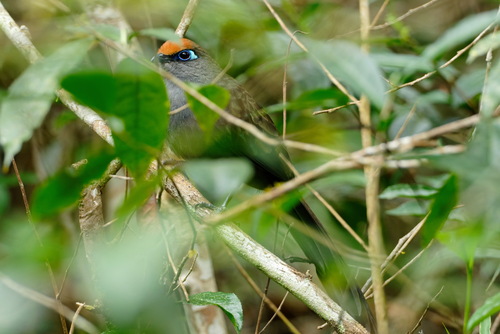
The blue coua (Coua caerulea) is a species of bird in the cuckoo family, Cuculidae. It is endemic to the island of Madagascar. This species was described by Carl Linnaeus in 1766. There was once twelve species of Coua but only eight or nine are still extant. The genus Coua derives from koa, the Malagasy name for a cuckoo. In French the bird is known as Coua bleu.

The bird's feathers are a deep blue and there is a distinctive blue oval area around the eye which is free of feathers. Like all cuckoos they have large feet, with a reversible third toe. It has a bulky silhouette and short, broad wings and long tail, all of which can be seen when gliding between trees. The average size of the birds is 48 to 50 cm (18.9 to 19.7 in) in length and 30 to 60 grams (1.1 to 2.1 ounces) in weight with the females slightly larger. The calls are evenly spaced ″koa koa koa″ notes and a brief ″brreee″.

The blue coua is an omnivore eating insects, fruits and small reptiles in subtropical or tropical dry forest, subtropical or tropical moist lowland forest, subtropical or tropical mangrove forest, and subtropical or tropical moist montane forest. The females... Wikipedia →

Sounds

Call0:15

Madagascar · 2025

© Joost van Bruggen · XC1079457 · CC BY-NC-ND 4.0

Alarm call0:13

Madagascar · 2013

© Mike Nelson · XC161997 · CC BY-NC-SA 3.0

Call0:18

Madagascar · 2024

© Francesco Barberini · XC937157 · CC BY-NC-SA 4.0

Global Distribution

Parks Where Found

# Park Country Daily sighting probability
1 Ranomafana National Park 🇲🇬 Madagascar
~60%
2 Mantadia National Park 🇲🇬 Madagascar
~50%

Zoos & Centres Where Found

# Zoo / Centre Country
1 San Diego Zoo 🇺🇸 United States In captivity
2 Prague Zoo 🇨🇿 Czechia In captivity
3 Walsrode World Bird Park 🇩🇪 Germany In captivity
4 Dallas World Aquarium 🇺🇸 United States In captivity
5 Rákosův pavilon 🇨🇿 Czechia In captivity
6 Velemlokárium 🇨🇿 Czechia In captivity

Before you go

What are the chances of seeing a Blue Coua in Ranomafana National Park?

Likely

About 60% of wildlife watchers report a Blue Coua sighting in Ranomafana National Park on a given day, based on 564 verified sightings from GBIF citizen-science data from 2019 to 2026. It is the 9th most-seen of the 102 birds we can rate there. Over three days the chance rises to about 90%, and over a week to over 90%, if each day is a fresh chance.

When is the best time to see a Blue Coua in Ranomafana National Park?

March

In that month about 80% of wildlife watchers report a Blue Coua in Ranomafana National Park on a given day, against about 50% in February, April–May and August, the lowest months. That is one of Ranomafana National Park's wettest months, with about 380 mm of rain against 80 mm in September. January and June have too few records to rate.

What time of day is best to see a Blue Coua?

Between 7 and 10 am

Across all the parks we cover, that three-hour window holds the most Blue Coua sightings with a recorded time, and about 8 in 10 of them come between 6 am and 6 pm: it is a daytime animal.

Is Ranomafana National Park the best place to see a Blue Coua?

Yes

Of the 2 parks where we can rate Blue Coua sightings, Ranomafana National Park has the highest daily chance: about 60%. Next come Mantadia National Park (Madagascar, about 50%).

Where does the Blue Coua sighting chance come from?

GBIF citizen-science records

It is estimated from how often the Blue Coua is recorded against all the birds logged in Ranomafana National Park (564 verified sightings from 2019 to 2026), calibrated against known sighting rates. Figures are rounded to the nearest 10% because citizen-science data supports honest approximations, not decimals, and months with records from fewer than five people show "—". How it works.

← Back to Ranomafana National Park