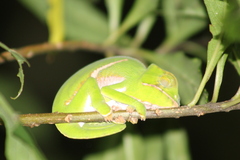
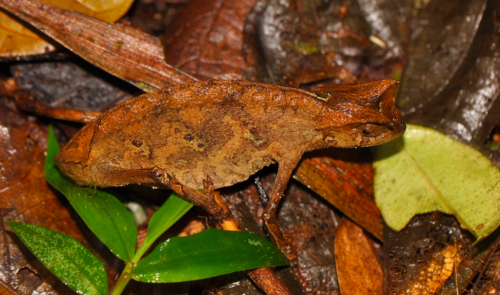
Two-banded Chameleon

Two-banded Chameleon

Furcifer balteatus

Silhouette: Ferran Sayol · PhyloPic

LCNTVUENEndangeredCR Endemic
Daily sighting probability ~50% · Likely
at Ranomafana National Park

In 3 days ~90% in a week >90%

56 Verified sightings at Ranomafana National Park From 2019 to 2026
56 In 1 park
February Best month
🌅 Crepuscular When it's spotted

About the Two-banded Chameleon

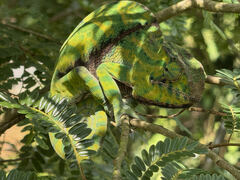
Furcifer balteatus, also known as the two-banded chameleon or the rainforest chameleon, is a species of chameleon that is endemic to Madagascar. It was described by André Marie Constant Duméril and Gabriel Bibron in 1851.

Furcifer balteatus is endemic to southeast Madagascar. It can be found in Ranomafana where the average temperature is between 14 and 20 degrees Celsius (57 and 68 degrees Fahrenheit) and the rainfall is roughly 4,000 millimetres (160 inches) per annum. It has been found over an estimated area of 1,971 square kilometres (761 square miles) but has a "patchy distribution" and is believed by the International Union for Conservation of Nature to be decreasing in population. Most sightings were at a height of 800 to 1,050 metres (2,620 to 3,440 ft) above sea level but some were at lower altitudes. It is a rare species and most of the sightings were of single individuals. Some surveys have failed to locate any individuals and it is ranked as an Endangered species by the IUCN. The major threat to this species is degradation of its forest habitat. It is a CITES-listed species and export from Madagascar has been banned since 1994. Nevertheless... Wikipedia →

Global Distribution

Parks Where Found

# Park Country Daily sighting probability
1 Ranomafana National Park 🇲🇬 Madagascar
~50%

More parks will be added in future updates.

Zoos & Centres Where Found

# Zoo / Centre Country
1 Fort Worth Zoo 🇺🇸 United States In captivity
2 Mandraka Reptile Farm 🇲🇬 Madagascar In captivity

Before you go

What are the chances of seeing a Two-banded Chameleon in Ranomafana National Park?

Likely

About 50% of wildlife watchers report a Two-banded Chameleon sighting in Ranomafana National Park on a given day, based on 56 verified sightings from GBIF citizen-science data from 2019 to 2026. It is the 9th most-seen of the 29 reptiles we can rate there. Over three days the chance rises to about 90%, and over a week to over 90%, if each day is a fresh chance.

When is the best time to see a Two-banded Chameleon in Ranomafana National Park?

February

In that month about 80% of wildlife watchers report a Two-banded Chameleon in Ranomafana National Park on a given day, against under 5% in September, the lowest month. That is one of Ranomafana National Park's wettest months, with about 430 mm of rain against 80 mm in September.

What time of day is best to see a Two-banded Chameleon?

Between 11 am and 2 pm

Across all the parks we cover, that three-hour window holds the most Two-banded Chameleon sightings with a recorded time, and about 7 in 10 of them come between 6 am and 6 pm: it is most active around dawn and dusk.

Where else can you see a Two-banded Chameleon?

Only Ranomafana National Park, in our data

Ranomafana National Park is the only park on Wallace's Line with enough records to rate Two-banded Chameleon sightings: about 50% of wildlife watchers there report one on a given day.

Where does the Two-banded Chameleon sighting chance come from?

GBIF citizen-science records

It is estimated from how often the Two-banded Chameleon is recorded against all the reptiles logged in Ranomafana National Park (56 verified sightings from 2019 to 2026), calibrated against known sighting rates. Figures are rounded to the nearest 10% because citizen-science data supports honest approximations, not decimals, and months with records from fewer than five people show "—". How it works.

← Back to Ranomafana National Park