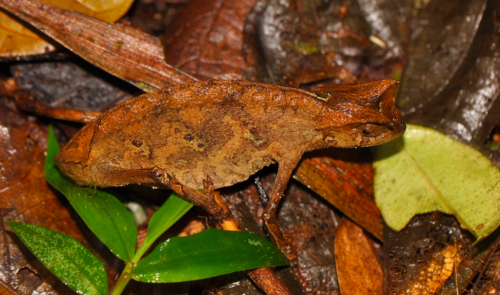
About the Parson's Chameleon
Parson's chameleon (Calumma parsonii) is a species of chameleon in the family Chamaeleonidae that is endemic to eastern and northern Madagascar. It is found from lowlands to an altitude of 1,195 m (3,920 ft) above sea level and mainly inhabits humid primary forest, but can also occur in disturbed habitats with trees. For a chameleon, it is very large, long-lived and slow-reproducing.
The specific name, parsonii, was coined in 1824 by Georges Cuvier in honor of British physician James Parsons. The Parson's chameleon is usually considered the world's largest chameleon by weight and one of the largest by length (where it is surpassed by the Malagasy giant chameleon). Adult males typically weigh 500–700 g (18–25 oz), have a casque on the top of their head and ridges running from above the eyes to the nose, forming two warty "horns". There are two recognized subspecies: The widespread nominate subspecies, Calumma p. parsonii, of both lowlands and mid-elevation altitudes, has no dorsal crest (no spines along the back's ridge) and reaches up to 65 cm (26 in) in total length including tail; there are reports of individuals exceeding 80 cm (31 in), but they... Wikipedia →